The short answer
BIFMA is the US trade association that writes the furniture standards American offices buy against, and a BIFMA claim on a desk or chair is a structural and safety testing claim — stability, strength, durability under repeated use. It is not a statement that the product fits your body. BIFMA publishes a separate ergonomics guideline, G1, which recommends the dimensions furniture should offer to fit a working population, and a product can be tested to the safety standard without meeting any particular height range. So treat a certification as evidence the thing is well built, and check fit yourself from the published numbers.
The short answer
Two different documents get collapsed into one badge in marketing copy. Keeping them apart is the whole trick to reading this category.
Who BIFMA is
The Business and Institutional Furniture Manufacturers Association. It develops the voluntary standards used for contract furniture in the United States — the furniture sold to offices by the floor, where a product has to survive a decade of strangers and a facilities budget that pays for repairs.
That origin is why a BIFMA claim is worth something on a product sold to a home buyer: the testing was designed for a much harder life than yours.
What the testing covers
Structural and safety behavior: whether a unit stays upright when loaded off-center, whether the structure holds under repeated cycling, whether surfaces and leg assemblies survive sustained use. For height-adjustable furniture that includes the lift mechanism being worked repeatedly rather than tested once.
It is about the furniture, not about you
Nothing in a structural test asks whether the desk descends low enough for a 5'2" user or climbs high enough for a 6'4" one. A desk with a narrow, badly placed height range can be perfectly well built and still be the wrong desk for your body.
The ergonomics guideline is separate
BIFMA publishes G1, an ergonomics guideline for furniture used in office work spaces, which is where recommended dimensions live. It is guidance about fitting a range of body sizes, not a pass/fail test, and a product being tested to the safety standard does not mean it follows G1.
This is the gap marketing copy tends to close for you. "BIFMA certified" beside a height range is two claims presented as one; only the first has been tested.
The practical consequence is simple and it is the same advice as everywhere else on this site: get your own number from the height calculator and check it against the desk's published range before anything else.
|
| BIFMA | US furniture structural and safety testing: stability, strength, durability under repeated use | Whether the height range fits your body |
| BIFMA G1 | An ergonomics GUIDELINE on dimensions for fitting a working population | Nothing is pass/fail; a product can be safety-tested without following it |
| TUV | German product safety and quality certification | Fit, and chemical emissions |
| GREENGUARD | Chemical emissions from the materials | Strength, stability or fit |
Reading a certification claim
- "Tested to BIFMA standards" vs "BIFMA certified". The second implies third-party verification; the first can mean the maker ran the tests. Both are better than silence, and they are not the same statement.
- A load figure beside a BIFMA reference is the useful version. Branch publishes a BIFMA-referenced 275 lb rating on its chair, which is a number you can check your own setup against.
- Other marks mean other things. TUV is a German product safety and quality certifier; GREENGUARD is about chemical emissions, not strength. SIHOO publishes BIFMA and TUV on the Doro C300; Lorell publishes GREENGUARD on its filing cabinets.
- No claim is not a red flag on its own. Plenty of good products skip certification because it costs money and home buyers rarely ask. Judge it alongside the published specs and the warranty.
Who publishes one
Among the products ranked here, the contract-furniture brands are the ones that state it: Steelcase rates the Series 1 to 400 lb and sells it into the same channel the standards were written for, Branch publishes a BIFMA-referenced 275 lb rating with an explicit fit range, and SIHOO states BIFMA and TUV certification on the Doro C300.
If you are buying for an employer rather than for yourself, this is usually the clause procurement cares about — the office-procurement page covers the rest of that purchase.
From the picks
Products that publish a standard
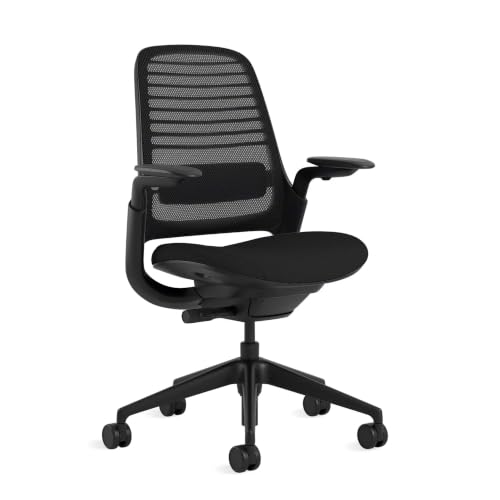
Height-adjustable lumbar support is the feature that matters for a bad back, and this is the cheapest Steelcase that has it — behind a 400 lb rating and a 12-year parts-and-labor warranty.
Best mid-price chair with published fit numbers
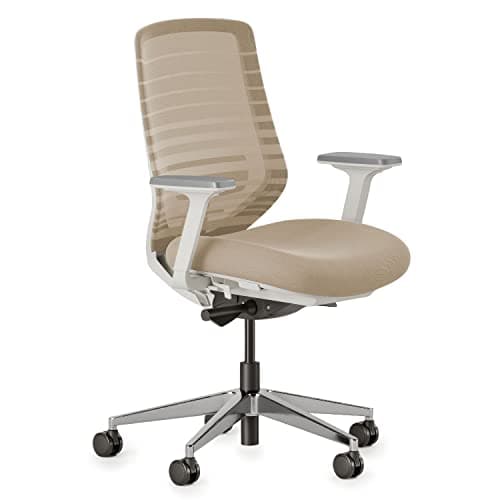
The only chair here that publishes the two numbers you can check against your own body: a 17" to 21" seat height and an 18" to 22" seat depth. Two-way adjustable lumbar, BIFMA-rated to 275 lb, seven-year warranty.
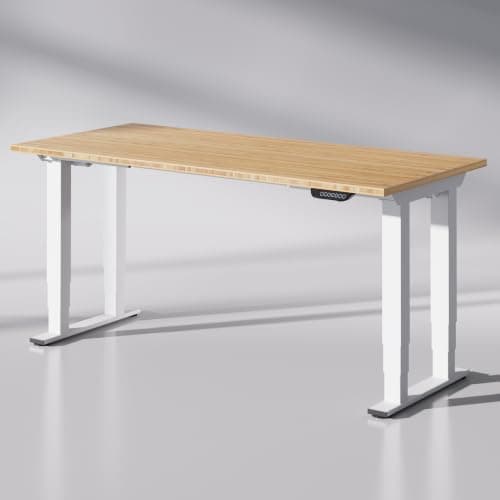
Four legs, 440 lb of lifting capacity and a 51.57" ceiling under a finished 72" x 30" top. It is the heaviest-duty desk we rank, and it is the only one that answers height and span at the same time.