The short answer
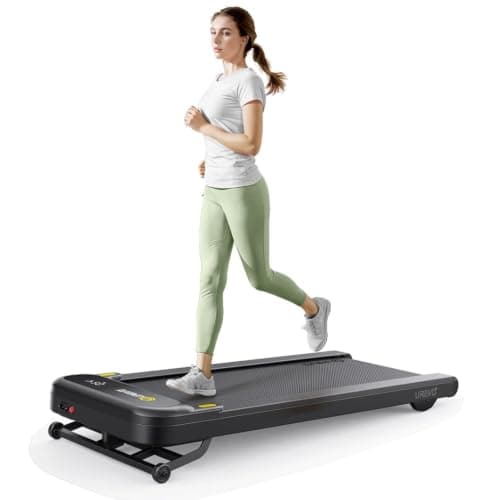
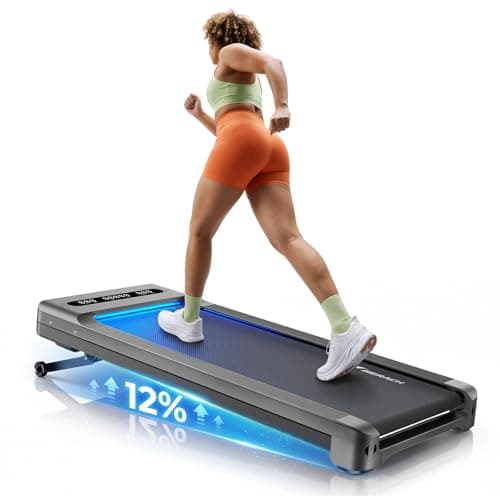
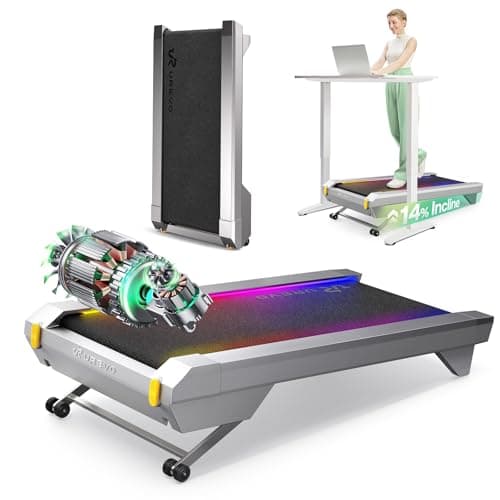
The UREVO SpaceWalk 3S is the incline pad we would put under a desk: nine levels of automatic incline (roughly 0 to 9%) on a 42.5 by 16.54 inch deck, which is the only pad here that adds incline without shortening the belt to the point of binding your stride. If you want the steepest grade and the highest weight rating, the UREVO CyberPad for Office publishes 0 to 14% automatic incline and supports users up to 400 lb — on a 39.4-inch belt, which UREVO's own spec makes the constraint for anyone much over 5'10". The MERACH UltraWalk W60 has the most incline steps at twelve and the best-documented motor, and it is the one designed to stay where you put it rather than fold away.
Why incline matters under a desk
On a normal treadmill, incline is one of two ways to work harder. Under a desk it is the only one, and that changes how much it is worth.
The reason is your hands. Above roughly 2.5 mph, most people's typing accuracy falls apart and their torso starts moving enough that reading a screen becomes work. So the speed range you can actually use while working is narrow — call it 1.0 to 2.5 mph — and it is nowhere near the 4.0 mph these pads top out at. Walking faster is not available to you.
Incline raises the effort at a speed you can still work at. A few percent of grade at 1.8 mph is a meaningfully different session from flat ground at 1.8 mph, with no change at all in what your hands and eyes are doing. That is the whole argument, and it is specific to this use case.
The honest limit on what this does
Incline makes a desk walk harder. It does not make it exercise in the sense a workout is exercise, and nobody should buy a walking pad expecting one. The best available evidence on sit-stand working is modest: Cochrane's 2018 review found low-quality evidence that sit-stand desks cut sitting by roughly 84 to 116 minutes a workday and concluded the health effects are still unproven. Treat a pad as a way to be less sedentary during hours you were going to spend at a desk anyway.
Automatic, manual and fake incline
Three different things get sold as incline and only one of them is worth paying for.
- Automatic incline is a motorized mechanism you change from the remote or the app while you are walking. All three pads here have it: UREVO states 0 to 14% automatic on the CyberPad and nine-level automatic on the SpaceWalk 3S; MERACH states twelve levels of automatic incline.
- Manual incline means you stop, get off, and move a prop or a set of feet. In practice this means you will set it once and never touch it again, which makes it a fixed-grade pad rather than an incline pad.
- Riser blocks and shims are the third thing, and they are what people do to flat pads. It works, it is free, and it is also how you end up with a pad whose feet are not all loaded — which is a stability problem on a moving deck.
The number of levels matters less than the top of the range. Twelve levels across 0 to 9% and nine levels across the same span are not meaningfully different experiences. A pad that reaches 14% is doing something a pad that reaches 9% cannot.
The three, measured
|
| UREVO CyberPad for Office | 0 – 14%, automatic | 39.4" x 16.5" | 0.6 – 4.0 mph | Up to 400 lb | Not published |
| UREVO SpaceWalk 3S | Nine levels, roughly 0 – 9% | 42.5" x 16.54" | 0.6 – 4.0 mph | Up to 265 lb | Not published |
| MERACH UltraWalk W60 | Twelve levels, automatic | 41.3" x 16.5" | Not published as a range | 400 lb peak, 330 lb sustained | Around 54 dB in average use |
The belt column is the ranking. The CyberPad has the steepest incline and the highest rating and the shortest deck, and UREVO itself flags the 39.4-inch belt as the constraint for a long-striding user — their own wording is that no amount of motor fixes it. The SpaceWalk 3S gives up five points of grade to get three more inches of deck, which is the right trade for almost everyone, because grade is a nice-to-have and stride length is not.
The MERACH is the odd one out in a useful way: it is the only pad here that publishes a continuous-horsepower figure (1.25 CHP, 3.5 HP peak), a cooling design and a noise figure in average use. At 67.7 lb it is also the one you will not be lifting into a closet — the main ranking treats that as a feature rather than a flaw, for the obvious reason that a pad you have to move is a pad you stop using.
What incline costs you
Three real costs, in order of how much they will bother you.
- Deck length. The incline mechanism lives under one end of the pad, and on a product whose whole selling point is being flat and thin, that space comes out of the belt. This is the trade behind every pad on this page.
- Height. An incline pad is thicker than a flat one, and at grade the front edge rises further. Everything under your feet comes off your desk's usable ceiling, so add the raised height — not the flat height — to your standing number from the height calculator before you buy either. On a desk with a 47-inch ceiling, a few inches of pad is the difference between working and hunching.
- Another motor to fail. The incline actuator is a second mechanism in a product that already lives under a desk getting stepped on daily.
If the ceiling arithmetic does not work out, the desk-and-pad pairing ranking starts from the desk instead and is the better page for you.
How to actually use it
A grade you cannot hold for forty minutes is a grade you will stop using, so start lower than you think.
The pattern that works, from the way everything else on this site is organized: keep the speed where your hands are happy, between about 1.2 and 2.0 mph, and move the grade rather than the speed when you want the session to be harder. Work in blocks rather than all day — UT Southwestern's guidance for standing desks is to change position, shift weight and take short breaks every thirty minutes, and the same logic applies to walking. How long to spend standing, with the evidence is the honest treatment of the dosage question.
One practical note on grade and footwear: walking on an incline barefoot or in socks loads your calves and Achilles differently than flat ground does, and more than people expect. If you are coming to this from a back-pain setup, introduce grade slowly and stop if your lower back is doing the work.
Why no prices appear in this text
Every number you see on this site is live
No dollar figure is typed into this page. Walking pad prices move weekly and this category discounts aggressively, so a price written into an article is wrong within a month. The buy buttons above show the live retailer price, or read "check price" where we cannot hold a verified figure.
What we left out, and why
Manual-incline pads. A grade you have to stop and rebuild is a fixed grade. They are not bad products; they are just not incline pads in the sense this page means.
The KingSmith WalkingPad C2. No incline at all, and it is the best pad we rank for a small room — it folds to 32 by 20 by 5.5 inches, which nothing here approaches. It belongs on the budget page and in its own review, not here.
Incline treadmills with handrails. They incline far more steeply and they do not fit under a desk, which makes them a different purchase entirely. The comparison is here.
Nothing on this page has been used by anyone here, and no grade figure above was measured by us. Every specification is the manufacturer's own published figure, cited below; where a maker publishes no noise or speed figure, this page says so rather than filling the gap.