The short answer
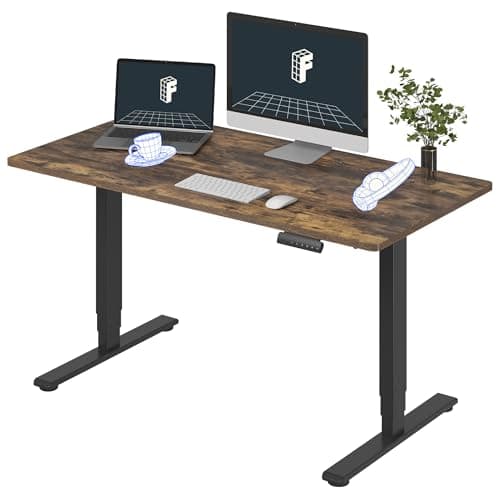
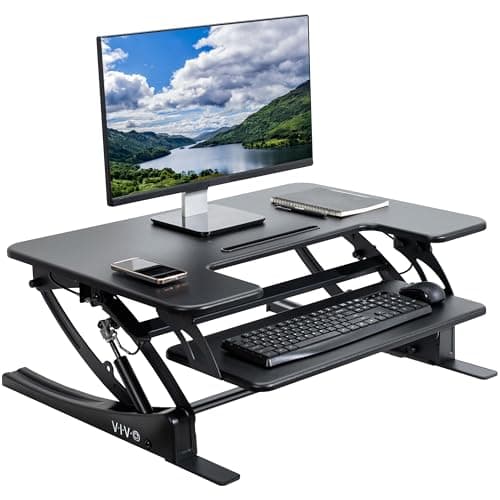
Buy electric. A hand crank removes the motor, which is the part most likely to fail, and in removing it also removes the only reason most people change height during a working day — a desk that takes a minute of cranking gets left at one height, which is the failure mode the whole category exists to avoid. The exception is worth knowing: the manual product that is genuinely good is not a crank desk but a spring-lift converter such as the VIVO 32-inch, which moves in one motion, has no power cable and nothing electronic to replace. If you want the cheapest electric desk that still does the whole job, the FlexiSpot E6 is three-stage with a 23.6 to 48.8 inch range; the E6 Pro is the same desk with 330 lb and ten years on the frame.
The short answer
Three ways to change a desk's height, and only two of them are worth considering:
- Electric. A motor in each leg, a controller, memory presets. Changes height in about ten seconds with one button.
- Hand crank. A handle under the desk and a gearbox. No power, no electronics, and roughly a minute of winding each way.
- Spring or pneumatic lift. A counterbalanced mechanism, usually on a converter rather than a full desk. One motion, no power, no winding.
The honest case for manual
It is not nothing, and three parts of it are real.
Nothing to fail electrically. On an electric desk the controller and the motors are the components that die, and they are also the components with the shortest warranty. FlexiSpot covers the E6 and E6 Pro control panels and electronics for two years, against five and ten years respectively on the frame and motor. A crank has no circuit board at all.
No cable, no socket. A manual desk can go anywhere in a room. An electric desk needs a socket, and every cable on a desk that travels two feet is a routing problem.
Silence. No motor noise at all, which matters in a shared room or on a call. For reference, the quietest motor pair we can cite a figure for is the E6 Pro's at under 45 dB.
The friction problem
Here is why those three advantages lose anyway. The entire benefit of a sit-stand desk comes from changing position several times a day, and a crank puts a cost on every single change.
The behaviour nobody budgets for
A desk with a two-second button press gets raised and lowered on a whim. A desk that needs roughly a minute of winding each way gets raised in the morning and left there — or, more often, never raised again after the second week. The desk did not fail. The habit did.
This is also why memory presets matter more than they look like they should. A preset returns the desk to a position you have already decided is right, which removes the fiddling as well as the effort. The FlexiSpot E6 and E6 Pro both carry four.
The research-backed pattern is alternating in fairly short blocks, not standing for a whole day. A mechanism that penalises each change works directly against the thing you bought the desk for.
What actually breaks on an electric desk
The fear driving the manual question is a dead desk in year four. It is a reasonable fear and it is addressable with the warranty text rather than with a crank.
The controller goes first. It is the part you touch, it carries a display, and on most desks it has the shortest cover. Two years on FlexiSpot's panel and electronics.
Then a motor or gearbox. Covered for five years on the E6, ten on the E6 Pro, and fifteen on the UPLIFT V3 — whose warranty text names the motors and electronics explicitly, which is the clearest statement in the category and the reason it tops the frame ranking.
Almost never the frame. Steel columns outlive everything else, which is why long warranties on frames are easy to give and warranties on electronics are not. Read the warranty scope rather than the warranty length and the failure risk is already mostly priced.
The manual product worth buying
If what you actually want is no motor and no power cable, buy a spring lift rather than a crank. A counterbalanced converter moves in one motion with no winding, so it keeps the manual advantages without the friction cost that kills the habit.
The VIVO 32-inch converter is the example: 6.5 to 17 inches of lift on a dual pneumatic spring with a touch height lock, 33 lb on the platform and 4 lb on the keyboard tray, a steel frame and a three-year warranty. It sits on the desk you already own, which is also the cheapest route into standing at all — as the cheapest-desk page sets out. The trade is desk depth and a keyboard that lives permanently above the desk surface, which the converter guide is honest about.
From the picks
What we'd actually buy
Two electric desks at the point where the price stops being the argument, and the one manual mechanism that is worth owning.
Three-stage legs, dual motors and four memory presets under a one-piece 55" top, at the price most two-stage desks ask. The 220 lb rating and the five-year frame warranty are what you give up.
FLEFlexiSpotE6 Pro Standing DeskNo licensed photo yet
The same footprint and the same range as the E6, with half again the capacity, a quieter motor pair and double the frame warranty. It is the version worth the difference for most desks.
The simplest useful converter here. One person, one laptop, one monitor, and it puts the keyboard on its own tier rather than leaving it up at screen height.
What the saving really is
Smaller than it looks. A crank desk saves the motors and the controller, and keeps the frame, the columns, the top and the shipping — the expensive parts. In practice the cheapest honest electric desks sit close enough to crank pricing that the saving buys you a worse daily experience rather than a meaningful amount of money.
This is why there is no crank desk in this site's registry. We rank products whose capacity, range and warranty the maker publishes, and the crank desks we could find either publish none of those or ask near-electric money for a minute of winding. Where that changes, the ranking will change with it.
Who should buy manual
- Anyone with no socket within reach of the desk, and no wish to run one.
- Anyone who will set a height once and genuinely never change it — a standing-only workstation at a bench or a till, for instance. Be honest about whether that is you.
- Anyone who already owns a desk they like, in which case the answer is the spring converter rather than a crank desk at all.
For everybody else: electric, with the warranty scope read before the warranty length. The budget ranking is where that decision usually lands.