The short answer
The MAGNUS Pro is the only sit-stand desk this site ranks that solves cable management as part of the desk rather than as an accessory: a steel (SPCC) frame and desktop with magnetic cable channels and a built-in tray, plus an integrated power supply column on the Amazon listing. It runs 25.6 to 49.2 inches, takes a 265 lb maximum distributed load, and carries a five-year warranty. Three figures decide whether it is right for you, and all three are honest drawbacks: the floor is the highest of any desk we rank, the desk itself is 125 lb of its own 265 lb load budget, and five years is a third of what UPLIFT and the FlexiSpot E6 Pro cover their frames for. Buy it for the cable system and the steel top; do not buy it as a capacity desk or a short-user desk.
The case for the MAGNUS Pro
There is one problem every sit-stand desk creates and almost none of them solve. The desk travels roughly two feet, several times a day, and drags every cable with it. Slack that looks tidy at seated height becomes a loop on the floor at standing height; a monitor power lead that reaches when the desk is down goes taut when it is up.
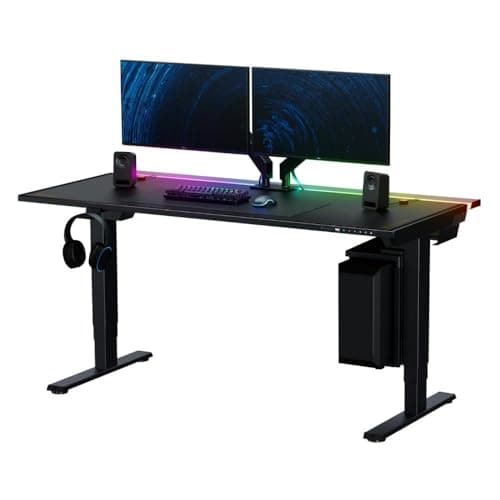
The usual answer is a tray, some adhesive clips and a weekend — which is what our cable guide walks through. The MAGNUS Pro's answer is a desk whose top is the cable system: magnetic channels in a steel surface, a tray built into the frame, and an accessory ecosystem that clings to it. That is why it wins our cable-management ranking and why it leads the page about how desks look — visible cabling is the single biggest reason a desk looks untidy in a room.
A steel desktop is the other half of the argument. It does not bow under a heavy monitor arm clamp the way a thin laminate top can, and it is the reason the magnets work at all. Secretlab also offers a bamboo-and-steel top for people who want the warmth back.
The published numbers
|
| Height range | 25.6" to 49.2" (650mm to 1250mm) |
| Maximum distributed load | 265 lb |
| Desk weight | 125 lb (1.5m); 150 lb for the 1.7m MAGNUS Pro XL |
| Construction | Steel (SPCC) frame and desktop; bamboo-and-steel top also offered |
| Cable management | Magnetic cable channels and a built-in cable management tray |
| Listed configuration | Ships with a black leatherette desk mat and an integrated power supply column |
| Warranty | 5 years |
Nobody here has used this desk. Every figure above is Secretlab's own published specification or a fact stated on the live Amazon listing, both cited at the foot of this page, and availability was confirmed before this review was written.
What the cable system actually does
Three parts, and it is worth separating what is structural from what is an accessory you keep buying.
- The magnetic channels. Cable runs clip to the underside of a steel top instead of hanging from adhesive hooks that let go in July. This is the part that cannot be retrofitted to any other desk, because every other desk we rank has a wooden or laminate top that a magnet ignores.
- The built-in tray. A place for the power strip and the brick pile, fixed to the frame so the whole mass travels with the desk rather than tugging at it. Trays are available for other desks as accessories; having one designed into the frame is a different experience from bolting one on.
- The integrated power supply column, which the Amazon listing describes as powering the desk and your devices through a single concealed cable in the desk leg with a built-in socket. In practice that is the difference between one cable leaving the desk and six.
The honest framing
Cable management is a real problem and this is a real solution. It is also the most expensive way to buy one. A tray, a sleeve and an hour will get most desks to 80% of this for a rounding error against the price difference — the MAGNUS Pro is for people who want the other 20% designed in rather than assembled.
The load figure needs reading twice
Secretlab publishes a 265 lb maximum distributed load, which looks mid-pack against the 330 lb FlexiSpot E6 Pro and the 355 lb UPLIFT frames. The number that changes the reading is the second one: the 1.5m desk weighs 125 lb on its own.
On a frame purchase the desktop you add counts against the rating, and here the desktop is already included — so the question is how Secretlab measures a distributed load on a desk whose top is part of the structure. Secretlab publishes the figure as a maximum distributed load, not as a lifting capacity, and it does not publish a separate lifting figure. Our weight-capacity guide explains why those are different promises, and the practical advice is the same as everywhere: treat the published number as a ceiling rather than a target, and leave margin.
For a normal loaded setup — two monitors on arms, a laptop, a tower on the floor — none of this binds. If you are planning a three-screen wall plus a heavy arm cluster, the heavy-duty ranking is the page you want, and the MAGNUS Pro is deliberately absent from it for exactly this reason.
The 25.6-inch floor
This is the specification most likely to disqualify the desk for you personally, and it has nothing to do with how well it is built.
At 25.6 inches, the MAGNUS Pro has the highest floor of any desk this site ranks. The FlexiSpot E6 and E6 Pro drop to 23.6 inches, the UPLIFT V3 frame to 22.6. A comfortable seated typing height is roughly 25 to 29 inches for most adults, so the MAGNUS Pro works seated for average and taller users and runs out of travel for shorter ones.
Check it properly rather than guessing: the height calculator gives you a seated number, and if that number is below about 26 inches this desk cannot reach it. No accessory buys a floor back. The short-user ranking sorts on exactly this figure.
The ceiling is less interesting: 49.2 inches is solid, a little under the UPLIFT V2's 50.1 and comfortably above the four-leg FlexiSpot 78x32's 47.2.
Five years, in a category that offers fifteen
Secretlab covers the MAGNUS Pro for five years. In most product categories that would read as generous. In this one it is the weakest number on the page.
|
| UPLIFT V2 and V3 frames | 15 years, naming desktop, frame, motors and electronics |
| Vari Electric Standing Desk | Lifetime against defects, non-transferable |
| Branch Standing Desk | 10 years |
| FlexiSpot E6 Pro | 10 years frame and motor, 2 years electronics |
| Secretlab MAGNUS Pro | 5 years |
Two things make that matter more than the headline suggests. A powered desk fails at the control box, the hand switch and the motors, not at the steel — and the parts of this desk that are most unusual (the power column, the proprietary accessory mounts) are also the parts least likely to have a generic replacement. Five years is the figure to price in, not to wave away.
What else does this job
- Any desk plus a tray and sleeve. The cheap route, and genuinely effective — the accessories page puts cable gear high in the buying order.
- The FlexiSpot E6 Pro. 330 lb, a 23.6-inch floor, ten years on frame and motor, and a one-piece slab — reviewed here. No cable system, lower price, better specification sheet.
- An UPLIFT V3. Lower floor, more capacity, triple the warranty, and you choose the top. The V2 versus V3 comparison covers which generation to buy while both exist.
- A Branch desk. The other "looks like furniture" answer, with a 52-inch ceiling and ten years.
Who should buy it
Buy it if a visible cable harness is the thing that bothers you about your current desk, if your setup is a two-screen gaming or work build where everything is powered from the desk, if you are average height or taller, and if you want a top that will not flex under a monitor arm clamp.
Do not buy it if your seated number is below about 26 inches, if you are buying on capacity, if you want the longest warranty your money can get, or if you are willing to spend an hour with a cable tray and a sleeve to save a meaningful amount of money. Those are four different people, and three of them have a better desk waiting on the main ranking.