The short answer
Sore feet at a standing desk are usually the result of standing still rather than of standing, so the fixes that work are the ones that reintroduce movement. In order of cost: sit down more often and in shorter blocks; shift your weight deliberately; put something under your feet; wear shoes rather than socks on a hard floor; and raise one foot occasionally. For the mat, a contoured one is the better answer to this specific problem — the Ergodriven Topo is 29 by 26.25 inches with mounds and a calf shelf designed to stop you standing still, 0.85 inches thick in the neutral area, on a 16-year warranty. If a chair has to roll across it, buy the flat Imprint CumulusPRO instead: 20 by 30 inches, three-quarters of an inch thick, with a lifetime warranty.
Why stillness is the cause
Standing is not hard work. Standing motionless on one spot for ninety minutes is, and the two get confused constantly.
When you stand without moving, the same muscles hold the same position continuously, your weight sits on the same part of each foot, and nothing is pumping fluid back up your legs. The symptoms people describe — aching arches, hot spots under the ball of the foot, tight calves, heavy legs by mid-afternoon — are all consistent with that, and all of them respond to movement rather than to cushioning alone.
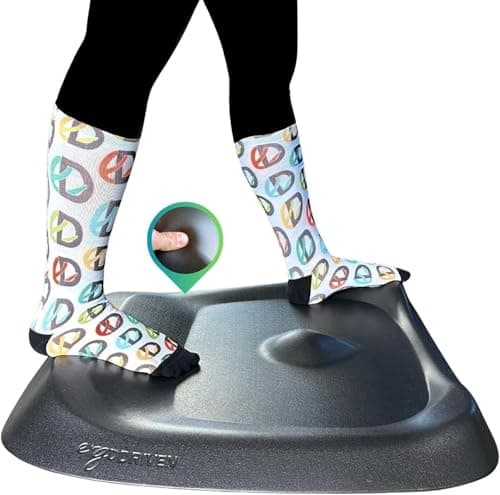
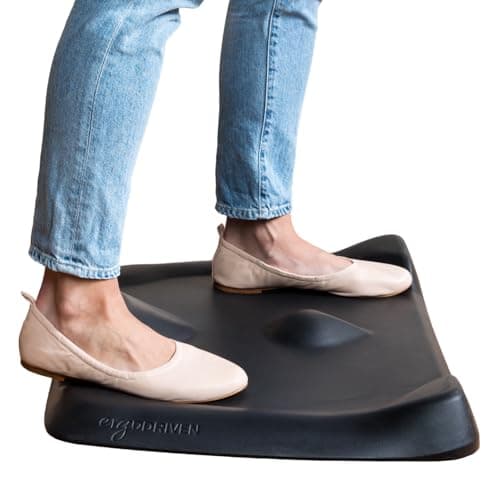
This matters because it changes what you buy. A thick soft mat makes a hard floor more comfortable and does nothing about stillness. A contoured mat is specifically designed to invite small shifts of position, which is why Ergodriven describes the Topo as deliberately not flat — the mounds and the calf shelf exist to give your feet somewhere to go.
The five fixes, in order
- Stand for less time, more often. Free, and the most effective change available. The pattern the research points at is alternating in fairly short blocks, not standing for a whole day. If your feet hurt, you are almost certainly standing in blocks that are too long.
- Shift your weight on purpose. Also free. Change which foot carries more weight every few minutes, and move your feet apart and together. This is what a contoured mat prompts you to do automatically.
- Put something under your feet. The cheapest purchase in this entire category, and the main subject of this page.
- Wear shoes. Standing in socks on tile or laminate removes all the cushioning your shoes would have provided. If a mat is not an option, shoes are the substitute.
- Give one foot somewhere higher to rest. A low box, a rail or the Topo's own calf shelf. Alternating which foot is raised changes the loading pattern.
Check this before buying anything
Desk height can cause foot pain indirectly: a desk slightly too high makes you reach up, which shifts your weight forward onto the balls of your feet and keeps it there.
Work out your standing elbow height and check the desk against it before you spend anything.
Contoured or flat
This is the one decision that matters, and for foot pain specifically the answer leans contoured.
A contoured mat — the Topo, or the smaller Topo Mini — has raised edges, mounds and a calf shelf. It is 2.7 inches tall at its highest point on the full-size version and 0.85 inches thick through the neutral middle, which is where you actually stand. The terrain is the feature: it makes standing still slightly less comfortable than moving, which is exactly the behaviour you want.
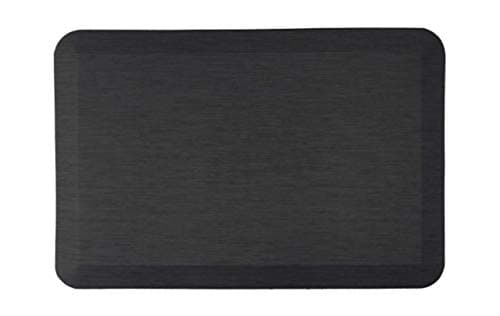
A flat mat — the Imprint CumulusPRO — is 20 by 30 inches of three-quarter-inch polyurethane with beveled no-curl edges, a non-slip bottom, certification by the National Floor Safety Institute, and a lifetime warranty on the core. It is the right choice in two cases: if a task chair has to roll across it, and if you share the space with somebody who will trip on terrain.
The contoured-versus-flat comparison goes through it in detail, and whether you need a mat at all depends mostly on your floor.
The three mats, measured
|
| Ergodriven Topo | 29" x 26.25" | 0.85" in the neutral area, 2.7" at its highest point | Contoured, with a calf shelf | 16 years |
| Imprint CumulusPRO | 20" x 30" | 3/4" | Flat, beveled no-curl edges, non-slip bottom | Lifetime |
| Ergodriven Topo Mini | 25.2" x 19.2" | 2.47" at its highest point | Contoured, 4 lb | 16 years |
Both Ergodriven mats are 100% non-toxic polyurethane foam with no PFAs, PVC, plasticizers such as phthalates, or added flame retardants — worth knowing for anything you stand on barefoot for hours.
From the picks
What we'd actually buy
The contoured mat for foot and calf pain, the flat one if a chair rolls across it, and the small contoured one for a tight footprint or a shorter user.
Best overall standing mat
A deliberately not-flat mat: the mounds and calf shelf exist to stop you standing still, which is the actual cause of standing-desk foot pain. Backed for sixteen years.
The flat mat to buy when a chair has to roll across it or a contoured mat is overkill. Three-quarter-inch polyurethane core, lifetime guarantee, beveled edges that do not curl.
Best for small spaces and shorter users
The Topo with four inches trimmed off every dimension and half the weight. Same foam, same sixteen-year warranty, meaningfully less floor.
Shoes and floors
Two variables that change the whole picture and cost nothing to check.
Your floor. Concrete and tile are the worst; laminate over concrete is nearly as bad; engineered wood on a suspended floor has some give; carpet over underlay already provides much of what a mat does. If you are standing on carpet and your feet still hurt, the problem is stillness or desk height, not the surface.
Your shoes. Hard-soled dress shoes concentrate pressure; worn-out trainers with collapsed midsoles are worse than people assume; socks on tile offer nothing at all. A mat compensates for a lot of this, which is why it is a cheaper fix than new footwear.
When it is not the desk
Foot pain that follows a pattern a change of behaviour does not touch is not a buying-guide problem. Pain that is sharp rather than aching, that is worst in the first steps of the morning, that is localised to one spot, that involves numbness or tingling, or that persists when you are off your feet entirely — none of that is answered by a mat, and none of it is something anybody here is qualified to diagnose. See a clinician.
The same goes for standing when you are pregnant, recovering from surgery, or managing a circulatory or joint condition: the right amount of standing in those situations is a medical question, not an ergonomics one.
If the ache is in your back rather than your feet, the back-pain mat page is the relevant one, and the back-pain guide covers what the evidence supports. If your legs feel heavy rather than sore, movement is the answer and a walking pad is the product.