The short answer
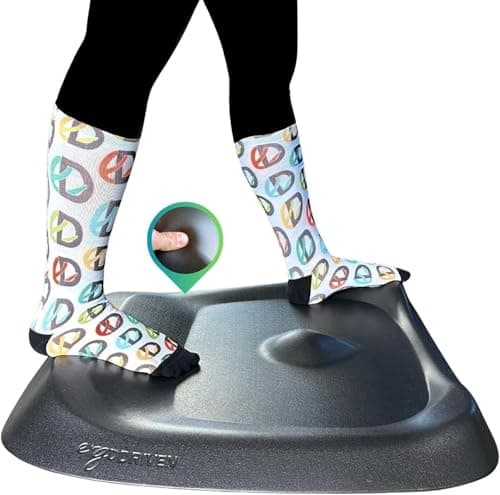
Yes, if you stand on a hard floor for more than about forty minutes at a stretch. A mat is the cheapest item in this category and the one most likely to decide whether you are still raising the desk in week three — not because standing hurts your feet so much as because standing still does, and a contoured mat gives your feet somewhere to go. The Ergodriven Topo is the pick for most people: 29 by 26.25 inches of non-toxic polyurethane foam with terrain up to 2.7 inches, under a sixteen-year warranty. You can genuinely skip one if you stand on carpet, if you work in supportive shoes all day, or if you share the spot with a rolling chair — in which case a flat mat like the Imprint CumulusPRO is the compromise rather than no mat at all.
The short version
The honest framing of this question is not "is standing bad for your feet". It is "what makes a standing habit survive".
Almost everyone who buys a sit-stand desk stands enthusiastically for a week and then quietly stops. The usual reason is not boredom; it is that standing still on a hard surface becomes uncomfortable in under an hour, and the easiest fix available in the moment is to lower the desk. A mat removes the thing making the first hour uncomfortable, and in doing so it protects a purchase that cost ten or twenty times as much.
That is the entire argument. It is a cheap insurance policy on an expensive desk.
What a mat actually does
Two things, and only one of them is cushioning.
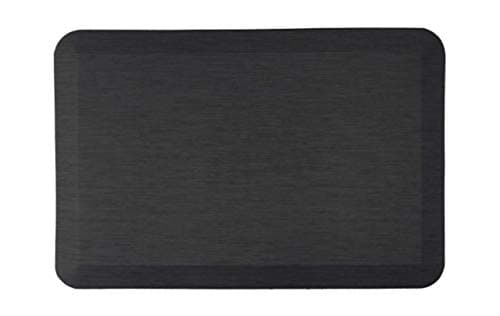
It cushions. Standing on a hard floor concentrates load through your heels and the balls of your feet. A dense foam layer spreads it. The Imprint CumulusPRO uses a 3/4-inch Cushion-Core polyurethane system, with a lifetime warranty and a core Imprint guarantees not to lose support over time — which is the thing cheap foam mats fail at, by flattening within months.
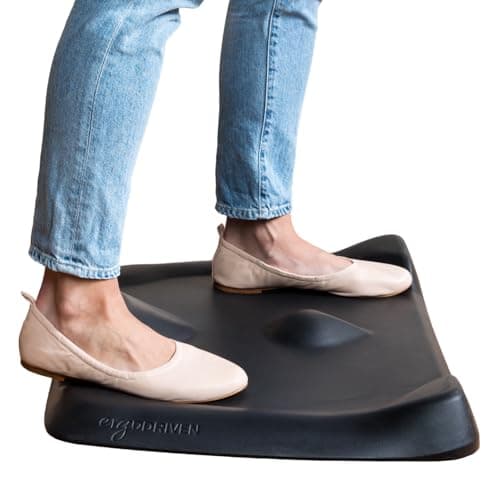
It prompts movement, if it is contoured. This is the part that matters more and gets discussed less. The problem with standing is static loading, not standing itself. A contoured mat gives you edges, mounds and a raised bar to shift onto, so your weight moves without you deciding to move it.
Why the movement part is the important half
UT Southwestern's guidance on sit-stand working is not "stand more". It is to change positions, shift your weight, and take short walk breaks every thirty minutes — and it warns that standing too much carries its own risks, including leg pain, swelling, and for at-risk patients deep vein thrombosis and varicose veins. A contoured mat is the cheapest way to do the shifting without having to remember to.
The Ergodriven Topo is built entirely around that second job: 29 by 26.25 inches, 0.85 inches thick in the neutral area and 2.7 inches at its highest point, in foam with no PFAs, PVC, plasticizers or added flame retardants, at 8 lb and a sixteen-year warranty. The head-to-head against a flat mat is the longer version of this distinction.
Your floor decides most of this
Before anything about mats, look down.
- Tile, concrete, polished stone. The hardest surfaces there are, and the clearest yes on this page. Concrete in a garage or basement office is the single strongest case for a mat.
- Hardwood or laminate over a subfloor. Still hard, with a little give. A mat is clearly worth it, and this is where most readers are.
- Carpet with underlay. You already have a mat, functionally. The cushioning case largely disappears. The movement case does not, which is the one reason to still consider a contoured mat on carpet.
- Thin commercial carpet tile over concrete. Feels like carpet, behaves like concrete. Treat it as a hard floor.
A floor note that is not about comfort: if there is a walking pad in your plan, the mat and the pad want the same patch of floor. That is a real conflict to resolve before buying either, and whether the pad earns its place is the honest first question.
Three cases where you can skip it
- You stand on real carpet. Covered above. Spend the money on a monitor arm instead, which is the higher-impact accessory on any sit-stand desk.
- You work in supportive shoes. Proper cushioned shoes do much of what a mat does. People who work from a home office in socks or barefoot are the ones who benefit most from a mat, and that is the majority — but if you keep trainers on at your desk, the marginal gain is small.
- You stand in short blocks. If your pattern is twenty minutes up, forty minutes down, you are never in the window where static loading becomes uncomfortable. A mat for that pattern is a nice-to-have, and the dosage question is worth reading because short blocks are a better pattern than long ones anyway.
And one case where a mat is actively the wrong product: if you sit in a rolling chair at the same spot, a contoured mat is something you will shove aside a dozen times a day — and a mat that lives against the wall is a mat you do not use. Buy a flat one, which a chair can be positioned around, or accept that the mat gets moved.
From the picks
The three we'd pick between
One contoured mat for standing still, one flat mat for a desk you also sit at, and one small contoured mat for a tight footprint.
Best overall standing mat
A deliberately not-flat mat: the mounds and calf shelf exist to stop you standing still, which is the actual cause of standing-desk foot pain. Backed for sixteen years.
The flat mat to buy when a chair has to roll across it or a contoured mat is overkill. Three-quarter-inch polyurethane core, lifetime guarantee, beveled edges that do not curl.
Best for small spaces and shorter users
The Topo with four inches trimmed off every dimension and half the weight. Same foam, same sixteen-year warranty, meaningfully less floor.
Which mat for which situation
|
| Standing on a hard floor, no rolling chair at that spot | Ergodriven Topo | 29" x 26.25", 8 lb | 0.85" neutral, 2.7" peak | 16 years |
| A spot you both sit and stand at, or a chair on casters | Imprint CumulusPRO Professional | 20" x 30" | 3/4" Cushion-Core | Lifetime; core guaranteed not to lose support |
| Tight footprint, a smaller user, or a second desk | Ergodriven Topo Mini | 25.2" x 19.2", 4 lb | 2.47" at its highest | 16 years |
Two notes on sizing that catch people out. The Topo Mini is four inches smaller in every dimension than the full Topo, and Ergodriven's own guidance is that above about a men's size 12 you will be standing off its edge, which defeats the point. And the CumulusPRO's beveled no-curl edge on a non-slip bottom is a genuine safety feature rather than a spec-sheet line — it is tested and certified by the National Floor Safety Institute, which matters on a mat you step onto and off several times an hour.
Contoured or flat
The short version of a longer argument: contoured if you stand still, flat if you also sit at that spot or walk across it.
A contoured mat solves the problem a flat mat only cushions. If your complaint is "standing gets uncomfortable after forty minutes", that is static loading and terrain is the answer. If your complaint is "my feet ache on tile", cushioning is the answer and a flat mat does it with a much smaller behavioral cost.
Flat mats also win on three practical points: they are easier to roll a chair over, they are easier to clean under, and they do not become a trip edge in a doorway or a walkway. Imprint's squared, beveled edge design exists for that reason. The full mat ranking and the buying guide both work through the thickness and density trade in more detail than this page needs to.
What a mat will not fix
Worth being clear, because mats get sold as medical devices and they are not.
A desk at the wrong height. If the desktop is above or below your standing elbow height, you are holding your shoulders wrong and a mat changes nothing about that. Run the height calculator, and if the desk cannot reach your number, the choosing guide is the page you need.
Standing too long. A mat makes a long standing session more tolerable, which is not the same as making it good for you. UT Southwestern is explicit that too much standing has its own risks, and Cochrane's 2018 review found only low-quality evidence that sit-stand desks reduce sitting by 84 to 116 minutes a workday, with health effects still unproven. The intervention that is actually supported is alternating, not standing.
A structural back problem. UT Southwestern states plainly that a standing desk cannot correct serious problems such as scoliosis or a bulging disc. If that is why you are here, the disc page and the back-pain guide are more careful about the limits than a product page can be, and the back-pain mat ranking is honest about what a mat contributes.
No mat on this page has been used by anyone here. Every figure above is Ergodriven's, Imprint's or the retailer's published specification, cited below, and every research claim is stated at the strength its source states it.