The short answer
A walking pad is worth it if three things are true: your desk reaches high enough with a pad under you, you have somewhere for it to live, and you have meeting-heavy or reading-heavy hours where walking will not wreck your output. If all three hold, it is one of the few purchases that converts sedentary desk time into movement without taking any time out of your day. If any one of them fails, it becomes an expensive object on your floor — and the honest alternative is a mat and a desk that actually fits you, which cost less and get used more.
The short version
The case for is simple and real: the pad removes the trade-off between working and moving. You are not choosing between an hour at your desk and a walk; you are getting both in the same hour. For anyone whose job is five hours of calls and reading, that is a genuinely large change in daily movement for no change in schedule.
The case against is equally simple: most people overestimate the share of their work they can do while walking. Typing accuracy falls apart for most people above about 2.5 mph, and anything requiring precision — code, spreadsheets, design work, careful writing — degrades well before that. If your day is mostly that kind of work, you are buying a pad for the two hours a week you can use it.
So the question is not whether walking pads work. It is whether your specific week has enough walkable hours in it.
What the evidence actually says
This matters because the marketing for this category is unusually enthusiastic, and the research is unusually modest.
The best available synthesis on working while not sitting is Cochrane's 2018 review of workplace interventions for reducing sitting. It found that sit-stand desks reduced sitting by roughly 84 to 116 minutes per workday in the short and medium term — a real effect — on low-quality evidence, with no evidence at all on longer follow-up. Cochrane's own plain-language summary is that the health effects of sit-stand desks and similar interventions are still unproven. That is the honest state of the field, and a walking pad is a more intense version of the same intervention rather than a different one.
What we will and will not claim
We will claim that a pad turns sitting hours into walking hours, because that is arithmetic. We will not claim weight loss, a back-pain cure, or a specific calorie figure for your body — the energy-expenditure research on standing is small per hour (UT Southwestern cites roughly 0.15 extra calories per minute for standing over sitting, about 54 calories across six hours), and walking is more than that but not a number we can give you honestly. If a page gives you a precise calorie figure for a pad, it made it up.
There is also a real caution. UT Southwestern's guidance on sit-stand working notes that too much standing carries its own risks — leg pain, swelling, and for at-risk patients deep vein thrombosis and varicose veins — and that a standing desk cannot correct serious structural problems such as a bulging disc. Walking is gentler on most of that than static standing, which is part of the argument for a pad. It is not a substitute for medical advice, and if you have a diagnosed back problem, the disc page and the sciatica page are more careful about this than a product page can be.
The four costs nobody lists
- Your desk's ceiling. The biggest one. A pad puts roughly four to six inches under your feet, and that comes straight off the usable height of your desk. A desk with a 47.2-inch maximum — and we rank desks with exactly that ceiling — can become unusable with a pad under it for anyone near six feet. Add your pad height to the standing number from the height calculator and compare it against the desk. If it does not clear, the desk-and-pad ranking starts from the desk instead.
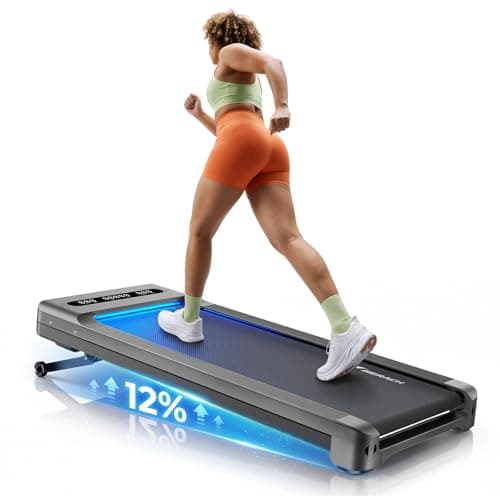
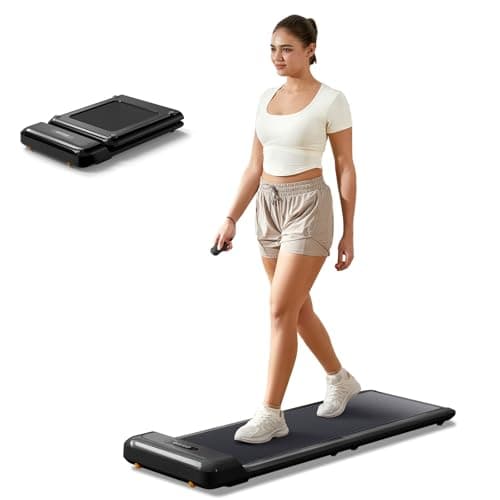
- Floor space, twice over. The pad needs somewhere to be when you are walking and somewhere to be when you are not. A pad that folds to 32 by 20 by 5.5 inches like the WalkingPad C2 solves this; a 67.7 lb pad like the MERACH is designed to stay put, and you need to want that. The space under the desk is also contested — a rolling cabinet and a pad do not both fit under a standard 60-inch top.
- Noise into the structure. Not the motor — your footfalls. A pad on a hard floor transmits every step into the building, which is a tenancy problem rather than a comfort one. The quiet ranking treats this as the primary constraint and concludes the floor matters more than the pad.
- Shoes, or the lack of them. Walking several miles a day on a deck in socks is harder on your feet than people expect. Most long-term pad users end up keeping a pair of shoes at the desk, which is a small cost and a real one.
From the picks
If the answer is yes, these are the three
One built to stay put, one that balances deck length against price, and one that folds flat enough to live in a closet.
A 400 lb peak rating on a 67.7 lb steel frame puts this in a different class from the light folding pads. It is built around the deck and the motor rather than around how small it folds.
Best incline pad for most people
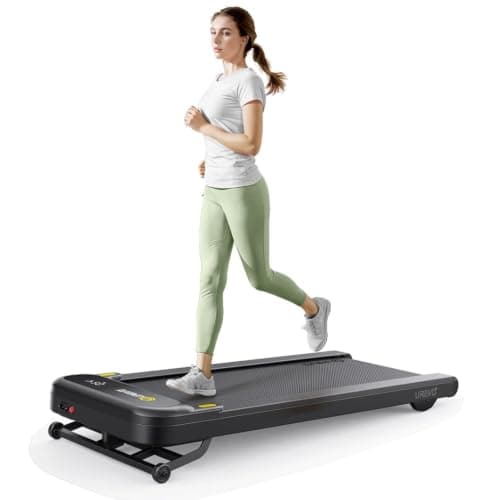
Nine incline levels and a 42.5-inch belt — the better balance of the two UREVO pads unless you specifically need the 400 lb rating.
Folds in half to a 32-inch footprint, which is the entire point. The 220 lb rating and 3.7 mph ceiling are the two limits to check against yourself before you buy.
Three cases where it is a clear yes
- Your calendar is calls. Four or five hours of meetings a day where you are listening and talking rather than typing is the single best fit for this product. The walking costs you nothing in output.
- You already have a desk that reaches high enough, and you use it standing. The pad is an upgrade to a habit that already exists rather than an attempt to start one. People who already stand for part of the day convert to walking easily; people who have never stood usually do not.
- You cannot get outside reliably. Shift work, a long winter, a city without walkable streets, caring responsibilities that keep you home. The pad is replacing a walk that genuinely was not going to happen.
Three cases where it is a no
- Your work is precision work. If the honest answer is that you cannot write code or build a spreadsheet while walking — and for most people that is the honest answer — the pad will get an hour a week. Spend the money on a desk that fits you and a chair that supports you, which get used all day.
- Your desk will not go high enough. This is a measurement, not an opinion, and it is the most common reason a pad gets returned. Do the arithmetic first.
- You have a diagnosed back or joint problem and no guidance on it. A pad is a lot of repetitive loading. Our back-pain guide is careful about what sit-stand can and cannot do, and the sensible order is advice first, purchase second.
Four checks before you buy
- Desk ceiling minus pad height, against your standing number. If that does not clear with an inch or two spare, stop here.
- Belt length against your stride. A walking stride at 2 mph is roughly 25 to 30 inches; you want the deck meaningfully longer, so 42 inches is comfortable and 39 is the practical floor. The stride arithmetic is here.
- Weight rating, plus 50 lb of headroom. These are duty ratings, not safety limits — running a pad at its ceiling daily is how it wears out.
- Where it lives on a day you do not use it. Answer this honestly before you order, not after it arrives.
What to buy instead
If the checks fail, the money is not wasted — it just goes somewhere with a better hit rate. In order:
A desk that fits your body. A sit-stand desk whose range covers both your seated and standing numbers gets used every day by definition. The choosing guide will get you to a shortlist in ten minutes, and the $400 page is where the real electric desks start.
A mat. The cheapest item in this whole category and the one most likely to decide whether a standing habit survives past week three. Whether you need one has a real answer.
Breaks you actually take. UT Southwestern's advice is to change position, shift your weight and take short walk breaks every thirty minutes. That is free, it is better supported than any product on this site, and the dosage page covers it properly.
Nothing on this page has been used by anyone here. The one product this site has lived with is a desk, not a pad. Every specification referenced above is the manufacturer's published figure and every research claim is cited below, stated at the strength the source states it.