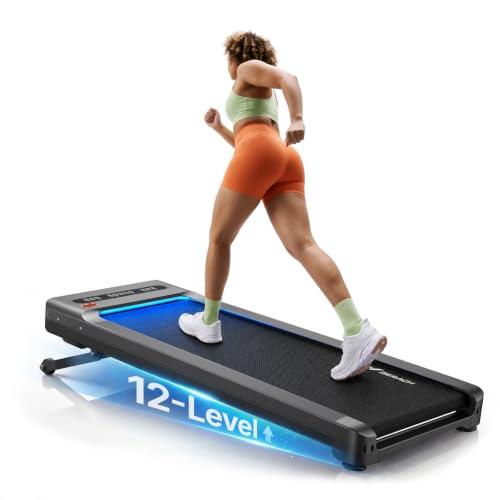
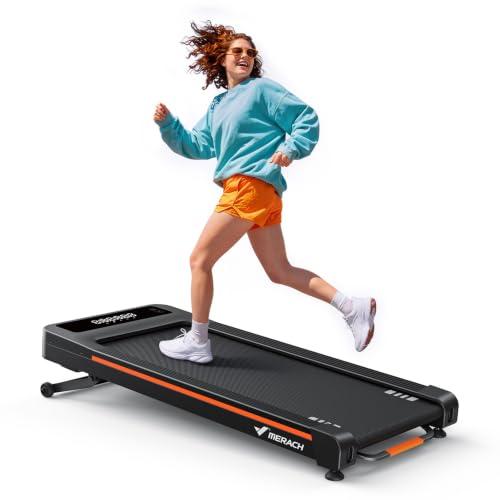
The short answer
A walking pad does not sit beside your standing desk — it goes under it, and it lifts you by its own deck height while you use it. So the desk has to reach your standing elbow height plus the thickness of the pad, which on the pads worth buying is roughly four to six inches. That single addition is what breaks most pairings: a frame that comfortably clears a 48-inch ceiling for standing runs out of travel the moment a pad goes under it, and there is no accessory that buys the inches back. Check the desk's published maximum against your standing number plus the deck, not against your standing number alone.
The short answer
Two products, bought separately, usually at different times, and almost never checked against each other. The walking-pad listing quotes a deck height. The desk listing quotes a height range. Nobody adds them together for you, and the sum is the only number that decides whether the combination is usable.
The arithmetic nobody prints
Standing height + deck height = the desk ceiling you need
Work out your standing elbow height first — that is where the desktop belongs when you are standing flat on the floor. Then add the height of the pad deck you will be standing on. The result is the figure the desk's published maximum has to clear.
Our standing desk height calculator gives you the first number in about thirty seconds. The second comes off the pad's own listing. Add them, then go and read the desk's ceiling.
A worked example with the frame this site recommends: UPLIFT publishes the V3 at 22.6 to 48.7 inches, a span it says fits over 95% of users — standing on the floor. Put a pad under it and the usable top of that range effectively drops by the deck height. For someone whose standing number is 44 inches, a five-inch deck asks the desk for 49 — and 49 is past where the V3 stops.
That is not a fault in the desk. It is the arithmetic, and it is why tall walkers end up disappointed by a pairing that looked fine on two separate product pages.
Why the desk ceiling fails first
Everywhere else on this site we argue that the floor of a desk's range is the number people check last and regret first — because the seated position is the one most desks get wrong. The budget-brand comparison turns entirely on six inches at the bottom.
A walking pad inverts that. The moment you are standing on a raised deck, the binding constraint moves to the ceiling, and the desks that handle a pad best are the ones with the highest published maximum rather than the lowest minimum. Our desks for tall users is the right page to read for a pad setup even if you are not tall, because it is sorted by exactly the number that matters here.
The under-desk bay
The second constraint is floor, not height. A pad with a 41.3-inch belt is longer than it looks once the frame and rollers are added, and whatever else lives under your desk is competing for the same rectangle.
The usual casualty is storage. A rolling pedestal and a walking pad do not both fit under a standard 60-inch top — that is a choice, and it is worth making deliberately rather than discovering it after both have arrived. Our under-desk storage page says the same thing from the other direction.
Two legs or four also matters here. A four-leg frame puts metal where the pad wants to go; a two-leg frame leaves the middle of the bay clear. Four-leg versus two-leg covers that trade in full, and for a pad setup the two-leg answer is usually right.
The pairing we would buy
A three-stage frame with the highest ceiling you can afford, and a pad with a belt long enough for your stride. The UPLIFT V3 is this site's desk pick on published range, capacity and a fifteen-year warranty, and MERACH's pads are the ones here with a 41.3-inch belt and a 400 lb frame rating behind them — which is the combination that survives being walked on daily rather than weekly.
The MERACH lineup, reviewed works out which of the two pads to put under it, and desks that work with a treadmill covers the rest of the desk field on the same criterion.
From the picks
The pairing, picked
UPLUPLIFT DeskV3 Standing Desk FrameNo licensed photo yet
Best current-generation buy
The V2's replacement, and the one that will actually be in stock. UPLIFT puts the range at 22.6" to 48.7" — a lower floor than the V2, which matters more than the ceiling for most people — on the same 355 lb rating and 15-year warranty.
A 400 lb peak rating on a 67.7 lb steel frame puts this in a different class from the light folding pads. It is built around the deck and the motor rather than around how small it folds.
Best MERACH for the money
The W60's deck, capacity and motor on a cheaper chassis: the same 16.5 by 41.3 inch belt and the same 400 lb frame, without the speaker and lighting the flagship spends on.
Which to buy first
The desk. It is the longer-lived purchase, it is the one with a range that either accommodates a pad or does not, and it is useful on its own from day one. A pad bought first can leave you with a desk requirement your budget will not meet.
Then walk before you buy the pad, if you can: a fortnight of standing tells you whether you will use one. Are walking pads worth it is the honest version of that question, and how long to stand covers what the evidence actually supports for either.