The short answer
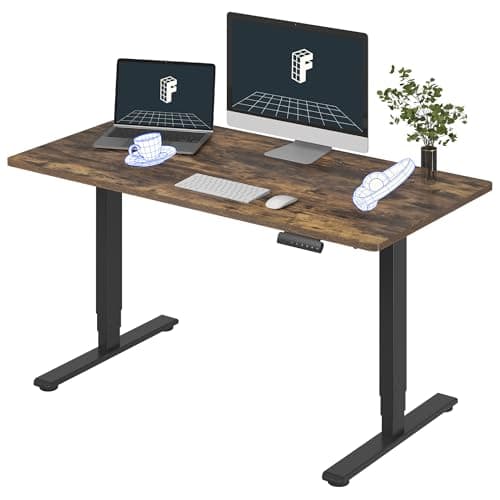
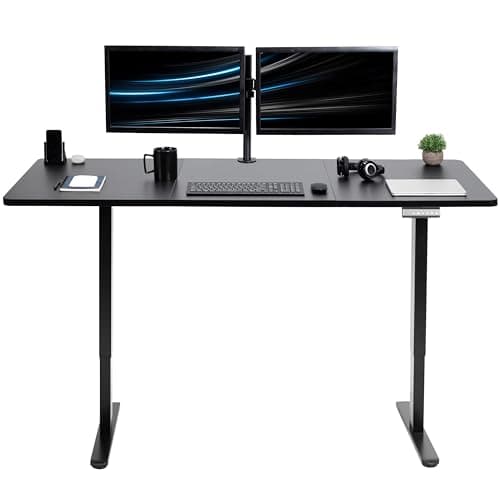
Buy the FlexiSpot unless you specifically need a near-six-foot top for budget money. The two brands look alike on a listing page — dual motors, memory presets, a complete desk in the box — but they fail in different places. FlexiSpot's E6 uses three-stage legs and publishes a 23.6" to 48.8" range, five years on the frame and motor, and four memory heights. VIVO's 71" x 30" E2 kit publishes a 29.5" to 48.3" range, three years of warranty, and three presets — but it includes a 70.9" desktop at a price where FlexiSpot gives you 55.1". So the question is not which brand is better. It is whether your binding constraint is how low the desk goes (FlexiSpot) or how much desk you get (VIVO). For anyone who will sit at this desk for part of the day, the floor wins that argument.
The decision in one paragraph
VIVO and FlexiSpot occupy the same shelf: complete electric sit-stand desks, sold on Amazon, assembled by you, at a price that makes a frame-only purchase from a premium brand look like a different category of expense. Neither is a bad buy. They are, however, built to miss in opposite directions, and most of the disappointment people report with either one traces back to buying the one that misses in the direction that matters to them.
The compressed version: FlexiSpot spends its money on the legs, VIVO spends it on the top. Three-stage legs are what buy a low floor and a high ceiling out of one frame, and FlexiSpot fits them to a desk that costs about what a two-stage desk costs. VIVO puts a near-six-foot desktop in the box instead, on a frame that cannot drop far enough to sit at comfortably.
The floor height is the whole argument
23.6 inches against 29.5 inches
A sit-stand desk has two jobs, and the seated one is the one people check last. The FlexiSpot E6 is published at a 23.6" minimum. The VIVO E2 71 x 30 is published at 29.5". That is a difference of nearly six inches at the bottom of the travel, and it is not recoverable with an accessory.
Why this matters more than the ceiling: a conventional fixed desk sits at about 29 to 30 inches, which is a compromise height chosen for an average adult male in shoes. A seated typing height that actually fits most adults falls below that — which is the reason to buy a desk that adjusts at all. A frame that stops at 29.5" has reproduced the fixed desk you already own and charged you for motors.
If you are short, or you work in a chair with any seat height below average, or you simply want your forearms level rather than angled up, a 29.5" floor is a permanent problem. Our standing desk height calculator will give you your own two numbers in about thirty seconds; check them against the table below before you spend anything.
The ceiling, by contrast, is close between these two: 48.8" on the FlexiSpot against 48.3" on the VIVO. Half an inch at the top will not decide anything for most people. Six inches at the bottom decides almost everything.
The published numbers, side by side
|
| Height range | 23.6" to 48.8" | 29.5" to 48.3" |
| Leg design | Three-stage | Two-stage, all-steel |
| Desktop included | 55.1" x 27.5", one-piece, FSC-certified wood | 70.9" x 29.5", 1" thick |
| Load capacity | 220 lb total | 220 lb |
| Motors | Dual, stated under 50 dB | Dual, 25mm/s |
| Memory presets | Four | Three |
| Warranty | 5 years frame and motor, 2 years electronics | 3 years |
Every figure above is the maker's own published specification or a fact stated on the live listing, both cited at the foot of this page. Nobody here has assembled either desk. Where a maker does not publish a number — neither brand states a deflection or wobble figure for these models — this page says so rather than inventing one.
What VIVO is actually better at
It would be easy to read the section above as "buy FlexiSpot" and stop. That would be unfair to what VIVO is doing, because one thing on that kit is genuinely hard to buy elsewhere at the price: a 70.9-inch desktop that arrives in the same box as the frame.
Width is the specification people underestimate and then pay for twice. Two monitors on arms, a laptop parked to one side and anything resembling paperwork will overrun a 55-inch top, and the usual fix — buy a frame, then source a six-foot slab separately — costs real money and introduces a sourcing problem most people would rather not have. VIVO sells the whole thing as one kit and says one person can assemble it, which at this width is unusual.
So the honest framing is: VIVO is the cheapest credible route to a near-six-foot sit-stand surface, and if you will stand at it most of the day and sit at it rarely, the floor height may genuinely not bind on you. Our six-foot desk ranking works through the rest of that category, and the full VIVO E2 review goes through this desk on its own terms.
Warranty: five years against three
FlexiSpot publishes five years on the frame and motor for the E6 and two years on the control panel and electronics. VIVO publishes three years on the E2. Neither is close to the fifteen years UPLIFT puts on a V-series frame, and that gap is most of what you are not paying for at this end of the market.
Read the structure, not just the headline. On both brands, the long number covers metal and motors; the short number — or no number at all — covers the controller, the handset and the wiring harness, which is the part most likely to fail on a cheap desk. A five-year frame warranty with two years on electronics is honest about where the risk sits. Our UPLIFT versus FlexiSpot comparison runs the same test one tier up, if you are weighing whether to spend more.
Capacity, and why both ratings are thin
Both desks publish 220 lb, which is the lowest rating of any full desk this site ranks. In isolation that sounds generous — very few desk setups weigh 220 lb. The catch is the convention: a desk rating is normally the lifting capacity of the frame, and on a complete kit the desktop is riding on it too. A one-inch particle-board top at near six feet is not a trivial fraction of that number.
In practice, 220 lb covers two monitors, a laptop, a dock and a lamp with room to spare. What it does not cover comfortably is a loaded desk that you also lean on — a monitor arm cluster plus a tower plus your forearms is a different load case than a spec sheet imagines. If your setup is heavy, neither of these desks is the answer, and the heavy-duty ranking is the page to read instead. We show the arithmetic on capacity separately, including why the margin matters mechanically rather than just as a safety limit.
Both lineups go wider than these two desks
The head-to-head above is the fairest single pairing — a complete FlexiSpot desk against a complete VIVO desk — but neither brand is one model.
FlexiSpot's range climbs a long way above the E6. The E6Q Premium is a four-leg desk with a 72" x 30" top, a 25.98" to 51.57" range and a 540 lb static / 440 lb lifting rating; it answers the width question VIVO answers, and answers the capacity question as well, at a much higher price and with a floor that is nearly two and a half inches above the E6's. FlexiSpot does not publish a warranty term on that listing, which is a real gap at that money. If four legs is the direction you are leaning, four-leg versus two-leg is the decision page.
VIVO's range runs the other way: down into converters, monitor stands and risers, where it is one of the most prolific brands on Amazon. That is worth knowing, because it changes what "buy VIVO" can mean — it does not have to mean buying this desk.
If neither desk fits, both brands sell a converter
Worth saying plainly: if your existing desk is fine and the problem is only that it does not rise, a converter sitting on top of it is the cheaper and less disruptive fix — and it sidesteps the floor-height argument entirely, because your current desk already sits at a height you tolerate.
VIVO is well represented there, and our converter ranking covers what to look for. The trade is real and we do not pretend otherwise: a converter versus a full desk costs you desk depth and adds a platform you have to lift. It is the right call more often than the standing-desk industry would like you to believe.
Who should buy which
Buy the FlexiSpot E6 if you will sit at this desk for a meaningful part of the day, if you are shorter than average, if four memory presets and a low floor matter more to you than inches of width, or if you want the longer of the two frame warranties. It is the safer default and it is the one most people should order.
Buy the VIVO E2 71 x 30 if width is the constraint that actually binds — two monitors on arms and a real work surface — if you stand for most of the day, and if you have checked your seated number against that 29.5" floor and can live with it. Buying it without checking that number is the mistake this page exists to prevent.
Buy neither if your setup is heavy, if you need to drop below 23.6", or if you are buying for a desk that already works and only needs height. Those are three different pages: heavy-duty desks, desks for short users, and how to choose a converter.
One last thing that is not a desk: if you buy either of these and start standing for real blocks of the day, the next thing you will feel is your feet, not your back. Our review of the Topo mat covers the cheapest meaningful upgrade to a budget standing desk, and the SIHOO Doro C300 review covers the seated half, which is still most of the day for most people.
Why no prices appear in this text
Both of these desks are discounted frequently and by large amounts, which makes any number written into prose wrong within weeks. The live price sits on the buy button for each desk above, pulled from Amazon and timestamped; when it cannot be refreshed, the button says so rather than showing you a stale figure. As a bracket rather than a quote: both sit at the budget end of the full-desk market, well below a premium frame bought on its own, and the gap between them is usually smaller than a single sale moves either one.