The short answer
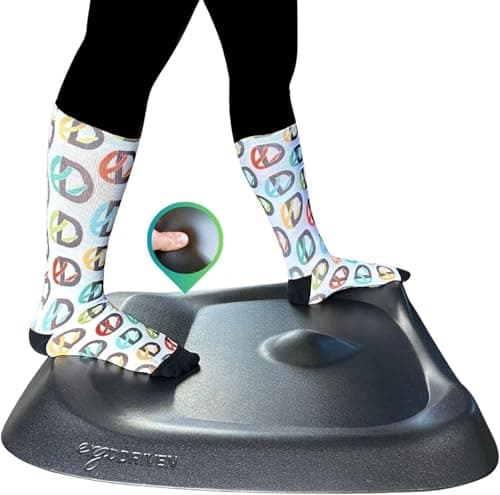
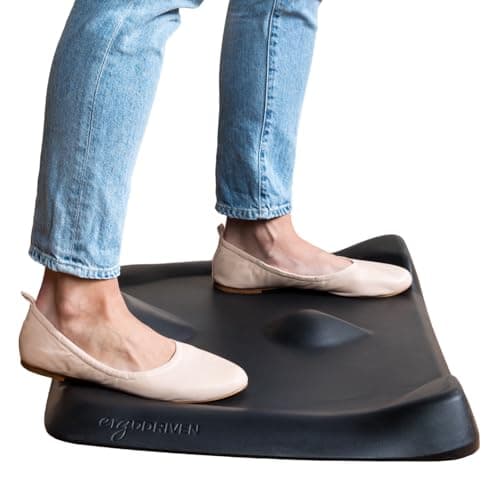
The Topo is the standing mat to buy if you stand for long, continuous blocks — and the reason is its shape, not its padding. Ergodriven builds in raised terrain and a calf-raise shelf specifically so your feet keep finding somewhere new to go, on the argument that static standing, not hard flooring, is what makes a standing desk hurt. The full-size mat is 29" wide x 26.25" deep x 2.7" at its highest point, 0.85" thick in the neutral area, 8 lb, made of 100% non-toxic polyurethane foam with no PVC, phthalates or added flame retardants, and carries a 16-year warranty behind a 90-day return window. Ergodriven recommends the full size for 5'5" and up and the Topo Mini for 5'4" and shorter. Two things rule it out: a rolling chair cannot cross it, and it costs several times a plain foam mat.
The verdict up front
There are two honest reasons to be skeptical of an expensive mat. The first is that foam is cheap and a mat is a piece of foam. The second is that the anti-fatigue category is full of claims nobody has to prove.
The Topo answers the first one and only partly answers the second. It is not priced as a piece of foam because it is not shaped like one: the molded terrain is the product, and it does something a flat pad cannot — it changes what your feet do while you stand. Whether that is worth several times a flat mat depends almost entirely on how long you actually stand. For an hour a day, no. For three or four continuous hours, it is the cheapest meaningful upgrade to a standing desk setup we rank.
The premise: not flat, on purpose
The problem is static standing, not hard floors
Ergodriven's stated design argument is that cushioned terrain drives you to move without thinking about it, and that the movement — rather than the cushioning — is what erases the fatigue caused by standing still. The mat is shaped to make standing in one position slightly unsatisfying.
This is worth taking seriously because it matches what goes wrong at a standing desk. People do not usually hurt because a floor is hard; they hurt because they lock out their knees, settle onto one hip and stay there for two hours. A flat mat cushions that posture. It does not interrupt it.
In practice the terrain gives you a small number of defined places to put your feet — raised edges, a crowned middle, and a wedge at the back for calf raises — and the result is that shifting position becomes the default rather than something you have to remember. That is the whole design. If you find the idea gimmicky, our contoured versus flat comparison argues the other side properly, with the flat mat winning on the grounds that matter to it.
The calf shelf deserves a specific mention, because it is the feature people use most and notice least on a spec sheet: it lets you stretch your calves without stepping off the mat or interrupting what you are doing. Over a long standing block, that is worth more than another quarter inch of foam.
The published numbers
|
| Width (along your desk) | 29" | 25.2" |
| Depth (away from your desk) | 26.25" | 19.2" |
| Height at its highest point | 2.7" | 2.47" |
| Thickness in the neutral area | 0.85" | Not published separately |
| Weight | 8 lb | 4 lb |
| Material | 100% non-toxic polyurethane foam, pebbled integral skin | Same foam |
| Recommended for | 5'5" and taller | 5'4" and shorter, or a tight workspace |
| Warranty | 16 years | 16 years |
Nobody here has stood on either mat for a working year, and nothing on this page is a test result. Every figure above is Ergodriven's own published specification, cited at the foot of this page, and both listings were confirmed in stock before this review was written. Where Ergodriven does not publish a figure — there is no separate neutral-area thickness stated for the Mini — this page leaves it blank rather than estimating it.
Topo or Topo Mini — the height rule
Ergodriven gives an unusually specific recommendation, and it is the right place to start: the full-size Topo for 5'5" and taller, the Mini for 5'4" and shorter or where the workspace is tight. It also notes that above about 6'5" the Topo may start to feel small.
The reasoning behind the rule is stride and foot size rather than height as such. The mat only works if your feet can reach the features without hanging off the edges — the Mini gives up four inches of width and seven inches of depth, which is a lot of the room you have to shift your stance in. Larger feet will overhang it.
The second input is floor. The full-size Topo is 26.25 inches deep, which in a small room is a genuine amount of floor permanently committed to standing in one place. That is the honest argument for the Mini even for a taller user in a cramped setup — and at 4 lb, it is also the one you will actually move out of the way, which matters if you alternate with a chair. If floor space is the constraint across the whole setup, our small-space desk page covers the rest of it.
The foam, and what is not in it
Ergodriven publishes the material as 100% non-toxic polyurethane foam, and is explicit about the absences: no PVC, no plasticizers such as phthalates, and no added flame retardants. The surface is a pebbled integral skin rather than a separate cover — one molded piece, so there is no fabric layer to peel, no seam to split and nothing to delaminate.
Published material disclosure is rarer than it should be in this category, and it is worth something practical as well as reassuring. A mat is a large piece of polymer that lives in a warm room you breathe in all day, directly under your face for eight hours. A maker willing to name what is not in the foam is a maker you can hold to it.
Sixteen years, and ninety days
Two numbers, doing two different jobs. The 16-year warranty against manufacturing defects is the long-term claim, and on a foam product it is close to absurd in a good way — the failure mode of a cheap mat is that the core compresses and stops supporting you after a year or two, and a maker guaranteeing against defects for sixteen is making a statement about the core.
The 90-day return window is the one that actually matters when you order. A contoured mat is a thing you either get on with or you do not, and that is close to impossible to predict from a photograph. Ergodriven states returns and exchanges are free within 90 days of delivery, which is what makes trying it a low-risk decision rather than a gamble on a shape. Check the terms in force when you buy — return policies change, and the one that governs your order is the one on the page the day you order.
What a mat can and cannot be shown to do
Being straight about the evidence: a mat is a comfort intervention. The research base for standing desks generally is thinner than the marketing suggests, and the research base for anti-fatigue mats specifically is thinner still. Nobody can honestly tell you a mat will prevent an injury or fix a back.
What the Topo's design does have going for it is that the mechanism it claims — move more while standing — is the same mechanism almost every credible source recommends for standing-desk discomfort, and it is a mechanism you can verify on yourself within an afternoon. That is a lower bar than clinical evidence and a higher one than most mat marketing clears. Our guide to whether anti-fatigue mats work goes through what the evidence does and does not support, and the foot pain page lists the two changes to make before you buy anything at all.
The honest case against it
- A rolling chair cannot cross it. This is the disqualifying one. If you sit and stand at the same spot, you will be shoving a 26-inch mat out of the way a dozen times a day until you stop using it. Buy a flat mat — our ranking names one.
- It costs several times a plain foam mat. For an hour of standing a day, that is hard to justify on comfort alone.
- It is a lot of floor. 26.25 inches of depth, permanently, in one place.
- The terrain is not to everyone's taste. Some people want a flat cushioned surface and find a shaped one fidgety. The 90-day window exists for exactly this.
- It does nothing for your back directly. If the problem is your lower back rather than your feet and calves, the chair and the desk height are the levers — that is a different page.
Who should buy it
Buy the Topo if you stand in genuinely long blocks, if your standing spot is not also your sitting spot, if you have the floor for it, and if you are 5'5" or taller. It is the mat we recommend first, and the terrain is the reason.
Buy the Topo Mini if you are 5'4" or shorter, if your workspace is tight, or if you want a mat light enough to move daily. Same foam, same warranty, less room to roam.
Buy neither if a chair has to roll across the same floor, if you stand for an hour a day or less, or if you have not yet checked whether your desk is even at the right height — a mat will not rescue a badly set up desk, and the height calculator costs nothing. If the desk itself is still the open question, VIVO versus FlexiSpot covers the budget end of it.
Why no price appears in this text
The Topo and the Topo Mini both move in price, and a number typed into prose is wrong by the time you read it. The live price sits on the buy button for each mat above, pulled from Amazon and timestamped; when it cannot be refreshed, the button says so rather than showing you a stale figure. As a bracket: the Topo sits at the premium end of the mat market and the Mini meaningfully below it, with both costing several times a basic flat foam mat and a small fraction of any desk on this site.