The short answer
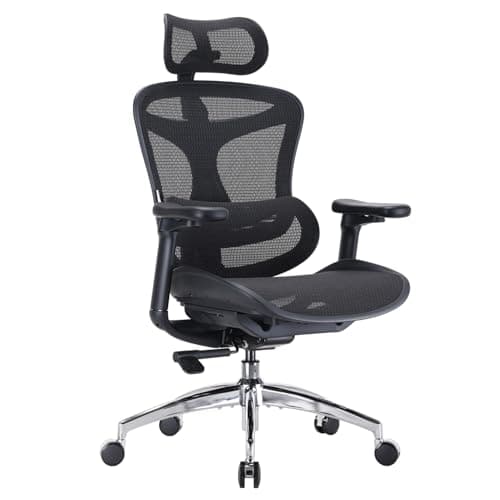
The SIHOO Doro C300 is the chair to buy when the budget will not stretch to a chair with height-adjustable lumbar support, and it is a genuinely good version of that compromise. SIHOO publishes a 330 lb maximum load, BIFMA and TUV certification, 4D armrests that move up, down, forward, back and sideways and swing with the backrest when you lean, a headrest adjustable for height, depth and rotation on an auto-lock, a weight-sensing recline to 130 degrees and a three-year warranty behind a 30-day trial. What you give up is the single adjustment that matters most for a long seated day: the lumbar support is "self-adaptive" — it conforms to your back as you move but cannot be moved up or down to sit on your curve. If your lower back is the reason you are shopping, spend more. If it is not, very little else at this price publishes numbers this specific.
The verdict up front
Budget office chairs are sold on a particular kind of language: "ergonomic design", "breathable mesh", "lumbar support" with no further detail. The reason to take the Doro C300 seriously is that SIHOO states figures instead — a load rating, two certifications, a recline angle, a defined set of armrest axes — and figures can be checked against your own body and against chairs costing three times as much.
This site already ranks it third in the home office chair ranking, behind two chairs that beat it on exactly one axis each. This review is the longer version of that placement, including the parts that argue against buying it.
The published numbers
|
| Maximum load | 330 lb |
| Lumbar support | Self-adaptive — adjusts to the contours of your spine as you lean, without manual adjustment |
| Armrests | 4D coordinated: up and down, left and right, forward and back, tilt linkage; soft PU coated |
| Headrest | Wide and adjustable for height, depth and rotation, with an auto-lock mechanism |
| Recline | Up to 130 degrees, on a weight-sensing mechanism |
| Seat | Waterfall-shaped seat pan; mesh back and seat |
| Overall dimensions | 28" W x 28" D x 42" to 49" H; 50.93 lb; requires assembly |
| Certification | BIFMA (US) and TUV (Germany), for quality and safety |
| Trial and warranty | 30-day trial; 3-year warranty, subject to the applicable terms |
Nobody here has sat in this chair for a working year, and nothing on this page is a test result. Every figure above is SIHOO's own published specification or a fact stated on the live Amazon listing, both cited at the foot of this page, and the listing was confirmed in stock before this review was written. Where SIHOO does not publish a number, this page says so — see the next two sections, where that happens twice.
What self-adaptive lumbar actually means
It moves with you; it does not move to you
SIHOO's lumbar support flexes against your back as you shift and lean, so it keeps contact through a range of positions. What it does not do is slide up or down the backrest so you can place the support at the height of your own lumbar curve. Those are two different features and the listings for cheap chairs routinely blur them.
The mechanical point is simple. Your lumbar spine curves inward; sitting — especially sitting while concentrating — flattens that curve as you slide forward and your pelvis rotates back. Lumbar support exists to hold the curve up. A support that sits two inches above or below where your curve actually is will press on the wrong vertebrae for eight hours a day, and no amount of "adaptive" flex relocates it.
Whether that matters to you is a question about your torso, not about the chair. Average torsos are well served by a fixed support height; longer and shorter ones are not. This is the whole reason our chair buying guide puts adjustable lumbar height first among the four adjustments worth paying for, and why the Steelcase Series 1 is the chair we point people to when the lower back is the presenting problem.
The honest counter-argument: a self-adaptive support in constant contact is still far better than the fixed foam bulge in a chair at half this price, and for a lot of people it is enough. We are describing a ceiling, not a failure.
The specification SIHOO does not publish
The gap worth knowing about before you order is seat height range. SIHOO publishes an overall chair height of 42" to 49" but no seat-pan height range, so you cannot check from the spec sheet whether the seat drops low enough or climbs high enough for you. Branch publishes 17" to 21" for its chair; SIHOO and Steelcase both leave the figure out.
The workaround costs nothing. Measure the chair you use now: sit with your feet flat and your thighs roughly parallel to the floor, then measure from the floor to the top of the seat pan at the front edge. That number is what you need the new chair to reach. If it falls in the normal task-chair band — very roughly 17 to 21 inches on most gas cylinders — you are unlikely to have a problem. If it does not, a chair that will not publish its range is a gamble, and the 30-day trial below is the reason the gamble is survivable.
The second absence is a published seat depth adjustment. If the front edge of a seat presses into the back of your knees you will slide forward off the backrest, and whatever lumbar support the chair has will be touching nothing. SIHOO states a waterfall-shaped seat, which is a front-edge profile designed to reduce exactly that pressure — but a profile is not the same thing as a depth adjustment, and this chair does not claim one.
The 4D armrests, and why they matter at a sit-stand desk
Armrests are usually the most over-sold part of a chair. Here they are worth attention for a specific reason: SIHOO states that the 4D armrests synchronize with the backrest when you recline, so your forearms stay supported as you move rather than sliding off a pad that stayed where it was.
The sit-stand angle on armrests is clearance, not comfort. If your desk has a keyboard tray bolted underneath, or a drawer, or a cable tray, the armrests have to clear it when the desk is at its lowest seated position. Four-way armrests help, because you can drop and retract them — but measure first. Our keyboard-tray desk page covers the clearance arithmetic, and it is the single most common reason a perfectly good chair does not fit a perfectly good desk.
The recline, the headrest and the seat
SIHOO states a recline to 130 degrees on a weight-sensing mechanism — the chair responds to how hard you lean rather than to a tension knob you have to dial in. That is a genuine convenience feature and a mild drawback: weight-activated recline sized for an average person can feel stiff if you are light and loose if you are heavy, and there is no published tension range to check.
The headrest is the part that is better than the price suggests. SIHOO states it adjusts for height, depth and rotation, on an auto-lock — three axes where a budget headrest usually offers one, or is a fixed decorative pillow. A headrest only earns its keep when you are reclining, which in practice means calls, reading and thinking rather than typing, but it is the kind of adjustment that gets quietly deleted at this price and here it was not.
Mesh back and mesh seat: this is the right call for anyone who runs warm or works through long unbroken seated blocks, and it is a worse call if you want a plush seat. Mesh seats are firmer than foam. That is not a defect, but it is a preference you should know you are expressing.
330 lb, BIFMA and TUV
A 330 lb maximum load is higher than plenty of chairs costing twice as much, and it is the sort of claim that is only worth anything if someone tested it — which is what the BIFMA and TUV certifications are doing on this listing. BIFMA is the US furniture standards body; TUV is a German product safety and quality certifier. SIHOO states certification by both.
Read a load rating for what it is: a structural statement about the base, the gas cylinder and the seat pan. It is not a statement about seat width, and it is not a comfort rating. A chair rated to 330 lb is a chair whose cylinder and five-star base were built and tested with margin, which is the same reason we argue for margin on desk capacity rather than treating the rating as a limit to run up against.
Three years, and a thirty-day exit
Three years is the weakest number on this page in competitive terms. Branch publishes seven years on its ergonomic chair; Steelcase publishes twelve on the Series 1, covering labor as well as parts. Against those, three years is a budget warranty, and you should price it as one.
What partly offsets it is the 30-day trial SIHOO states on the same page. For a chair whose seat height range is not published, a defined window in which you can decide the fit was wrong is worth more than it sounds — it converts the unmeasurable part of this purchase into a reversible one. Check the current terms before you rely on that, because return policies change and the one that governs your order is the one in force when you buy.
The honest case against it
- The lumbar support cannot be placed. If you are shopping because your lower back hurts, this is the wrong chair and the reason is structural, not a matter of degree. Start at our back-pain chair ranking instead.
- No published seat height or seat depth range. Two of the four fit numbers that decide whether a chair works for a body are simply absent.
- Three years of warranty. Less than half of Branch's, a quarter of Steelcase's.
- It requires assembly, at 50.93 lb in the box.
- It is a chair, not a posture fix. The intervention with the best evidence behind it is changing position often, which is behavior rather than a purchase — how long to stand covers what the research actually supports.
- It does nothing for the standing half of your day. If your feet and calves are what hurt, that has a different fix order, and it starts with changes that cost nothing.
Who should buy it
Buy it if you want the most published specification per dollar in a task chair: a tested load rating, two certifications, genuinely adjustable armrests and headrest, and a mesh back that will not cook you through a long afternoon. Buy it also if you are furnishing a second desk, a shared room or a setup you are not yet sure you will keep — the trial window makes it a low-regret purchase.
Do not buy it if lumbar placement is the thing you are actually shopping for, if you need a published seat height range because you sit at the edges of average, or if you want a warranty that will still be running in a decade. Those are three arguments for spending more, and the ranking that places this chair third names the two chairs that answer them.
And if the desk is not sorted yet, the desk is the better place to spend first — a good chair at a desk that cannot drop to your seated height is still the wrong height. VIVO versus FlexiSpot covers the budget end of that decision, where the floor height is the number that decides it.