The short answer
For a home office where you sit most of a working day, the Steelcase Series 1 is the pick: it publishes height-adjustable lumbar support that slides to land on your own lower-back curve, a 400 lb rating, and a twelve-year warranty that covers labor as well as parts. The Branch Ergonomic Chair is the one to buy if you want to verify fit before you order — it is the only chair here that publishes a seat height range (17" to 21") and a seat depth range (18" to 22"), and its armrests come off entirely. The SIHOO Doro C300 is the budget answer at a 330 lb load rating with BIFMA and TUV certification, and its compromise is specific: the lumbar support adapts to you automatically rather than letting you place it. Nobody here has sat in these chairs for a working year. Every figure on this page is the maker's own published specification, cited at the foot of the page, and each listing was confirmed in stock before it was ranked.
The shortlist, and why it is three chairs
Most "best desk chair" lists run to twelve entries. This one runs to three, because three is how many chairs we could find whose makers publish enough to let a buyer check the claim. That is the whole bar: a chair has to state, in public, the numbers that decide whether it fits a specific human body.
It is a harsher filter than it sounds. Office chairs are sold almost entirely on things that photograph well — mesh weave, a headrest, armrests that move in four directions, a recline that goes nearly flat. Almost none of it decides whether you are comfortable in hour six. What decides that is whether the lumbar support lands on your lumbar curve and whether the front of the seat stops before the back of your knees, and those are measurements, not features.
|
| Lumbar support | Height-adjustable — slides up and down | Padded, two-way adjustable, height-adjustable | Self-adaptive; no manual adjustment |
| Seat height range | Not published | 17" to 21" | Not published |
| Seat depth | Height- and depth-adjustable (range not published) | 18" to 22" | Not published |
| Weight capacity | 400 lb | 275 lb (BIFMA commercial-grade) | 330 lb |
| Armrests | Vary by configuration | 3-way adjustable and removable | 4D coordinated, plus headrest |
| Warranty | 12 years, parts and labor | 7 years | 3 years |
| Assembly | — | — | Requires assembly |
Read that table across rather than down and the three chairs stop competing on price and start competing on what their makers are willing to put in writing. Steelcase publishes the longest warranty and the highest capacity but no seat height range. Branch publishes the fit numbers and the shortest fit range. SIHOO publishes the biggest number for the least money and the least adjustment.
What we ranked on
Four criteria, weighted, and applied identically to every chair on the site — the full method is published. In order of weight:
1. Lumbar support that you can place (30%)
Not "has lumbar support". Nearly every chair sold has something the marketing calls lumbar support, and most of it is a fixed bulge molded into the backrest at the height of an average torso. The useful version moves vertically, so it lands in the inward curve of your lower back.
The mechanics are unglamorous. The lumbar spine curves inward; sitting — especially sitting while concentrating — flattens that curve as you slide forward and your pelvis rotates back. Support exists to prop the curve up. Support sitting two inches above or below where your curve actually is will press on the wrong vertebrae for eight hours a day, which is worse than nothing, because it actively holds your spine in the shape the chair expected.
2. Adjustability, especially seat depth (25%)
Seat depth is the quiet half of the lumbar argument and the adjustment most buyers have never heard of. If the front edge of the seat presses into the back of your knees, you will slide forward to relieve it, your back will leave the backrest, and the lumbar support you paid for will be touching nothing at all. A chair with perfect lumbar support and a seat two inches too deep is a chair with no lumbar support.
3. Warranty scope, then length (20%)
The parts that fail on a task chair are the gas cylinder, the casters, the armrest mechanisms and the foam or mesh. Each is cheap on its own and annoying enough that most people buy a new chair instead. So we read scope before length, the same way we read desk warranties: twelve years covering labor is worth more than a longer number that quietly excludes the mechanism.
4. Fit with a desk that moves (15%), then value (10%)
This is a sit-stand site, so the last structural criterion is what happens to a chair in a setup where the desk travels two feet several times a day. It is covered in its own section below, because it is the thing no general chair review tests for.
What we did not rank on
Comfort. Nobody here has sat in these chairs for a working year, and a comfort score invented from a spec sheet would be a lie dressed as data. Every number on this page is a published figure you can check at the source. The scores are editorial judgments about those published figures — not test results.
1. Steelcase Series 1 — best overall
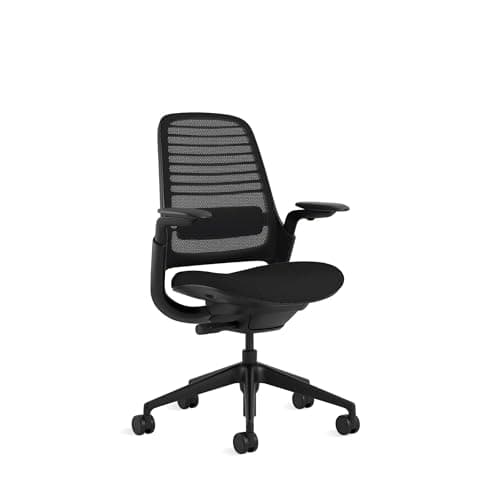
The Series 1 wins on the first criterion and does not give the lead back. Steelcase publishes height-adjustable lumbar support that slides up and down to sit in the curve of your lower back; the seat adjusts for both height and depth; the recline is weight-activated with an upright lock, so there is no tension dial to set wrong.
Two figures explain where it came from. It is rated to 400 lb, where most task chairs in its bracket publish 250 to 300. And Steelcase covers it for twelve years on parts and labor in the US and Canada — a warranty written for a facilities manager who expects a technician, not a cardboard box. This is the entry point into Steelcase's contract line, the furniture sold to offices by the floor, and the over-engineering is a side effect of being specified for a whole working population rather than one buyer.
The practical trap is the listing, not the chair: the Amazon configuration is floor specific. The one linked here is the Carpet Floors version in Licorice. Casters are matched to the floor they roll on — carpet casters are harder so they do not sink, hard-floor casters are softer so they do not mark — so look down before you order. The full Series 1 review works through the configuration list and the case against it.
Honest cons. It costs several times a generic mesh chair, and if you sit three hours a day you may not feel the difference. Arms and lumbar are separate options on some configurations, so the build sheet needs reading. And Steelcase does not publish a seat height range on the sources we cite, which is a real gap on a product whose entire argument is fit.
2. Branch Ergonomic Chair — best fit information
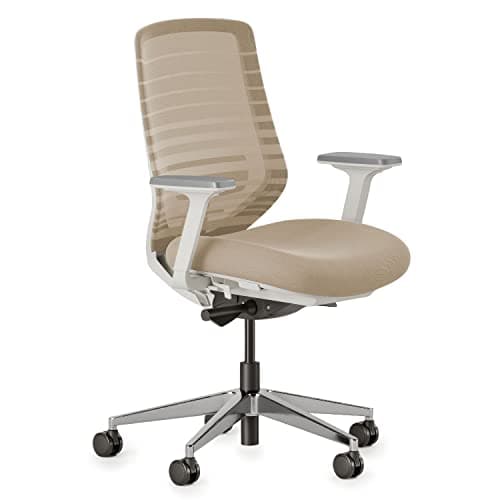
Branch does the thing almost nobody in this category does: it publishes the measurements a buyer could actually use. Seat height 17" to 21". Seat depth 18" to 22". Armrest height 26" to 29". A 20-degree tilt range on a weight-activated recline. Padded, two-way adjustable lumbar. And then — unusually — a stated fit range: Branch says the chair is best for people 5 ft 2 in to 6 ft 2 in, up to 275 lb, at 8+ hours a day.
That last line is the most useful sentence any maker on this page writes, and it cuts both ways. It tells a 5 ft 4 in buyer the chair was designed with them in mind. It also tells a 6 ft 5 in buyer to stop reading, which is worth far more than a vague claim that the chair suits everyone.
The armrests come off
Three-way adjustable and removable. On a desk that travels, the armrests are what collide with the underside of the desktop, a keyboard tray or a drawer pedestal — and a removable armrest is a permanent fix for a clearance problem that otherwise costs you the chair.
The chair is BIFMA-rated for commercial-grade use at 275 lb and carries a seven-year warranty, which sits sensibly between the Series 1's twelve and the Doro C300's three.
Honest cons. 275 lb is the lowest capacity of the three — below the Series 1's 400 lb and the Doro C300's 330 lb. Branch's own stated fit range stops at 6 ft 2 in, so tall buyers are explicitly outside it. And the warranty term does not state labor coverage the way Steelcase's does, so a mechanism failure in year six may still cost you a service call.
3. SIHOO Doro C300 — best budget pick
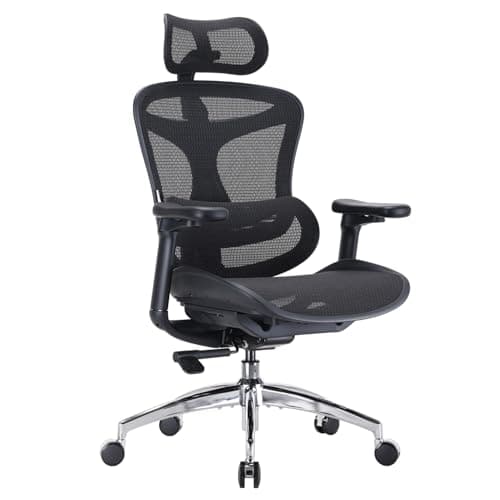
The Doro C300 is here because it publishes real numbers rather than adjectives, which is rare at the bottom of this category. A 330 lb maximum load. Environmental certification from both BIFMA and TUV. 4D coordinated armrests and a wide adjustable headrest. A recline to 130 degrees. Overall dimensions of 28" W x 28" D x 42" to 49" H, at 50.93 lb. Mesh back and seat, which matters more than it sounds through a long seated block — a chair that holds heat is a chair you get out of.
The compromise is exactly where our top criterion sits. SIHOO's lumbar support is self-adaptive: it adjusts to the contours of your spine as you lean back, without manual adjustment. That is a genuine engineering approach and it is not the same product as the Series 1's sliding support. One lets you place support on your curve; the other decides for you. Our rubric scores the second lower on purpose, and that is the rubric working rather than a thumb on the scale — a chair that costs a third as much and loses only on the heaviest-weighted criterion is a good buy, not a bad one.
Honest cons. The lumbar support is not placeable. No seat height range is published, so you cannot check fit from the spec sheet before ordering — the same gap the Series 1 has. Three years of warranty against Branch's seven and Steelcase's twelve. And it requires assembly, where the Series 1 arrives built.
The number two of these three do not publish
Seat height range. Branch publishes 17" to 21". Steelcase and SIHOO do not publish one on the sources cited here, and that is the single most frustrating gap in this whole category, because it is the one measurement that decides fit before anything else gets a chance to.
Here is what the number is for. Sit with your feet flat and your thighs roughly parallel to the floor, and measure from the floor to the back of your knee. That figure is the seat height you need. Most adults land between 16" and 21", and most task chairs cover roughly 17" to 21" — which means short buyers get squeezed out at the bottom far more often than tall buyers get squeezed out at the top.
If a maker will not publish the range, the honest advice is to measure yourself first, then buy from a retailer with a return policy you have actually read. We are not going to estimate the missing number, because a chair bought on an estimate that turns out to be an inch wrong is a chair you will resent for a decade.
What changes when the desk moves
This is where a sit-stand setup diverges from a normal desk, and it is four checks rather than one.
You still need a real chair. Nobody stands all day — the pattern the research points at is alternating in fairly short blocks — so for most of a working day a sit-stand desk is a sitting desk. A good chair makes the seated half better. It does not replace the standing half, and a stool does not replace the chair.
The chair and the desk have to meet in the middle. Set your seated desk height from your elbows with the chair already adjusted — the calculator produces that number — then check that your desk actually reaches it. This is where desks with a high floor cause trouble: a FlexiSpot E6 drops to 23.6" and a Desky Dual to the same 23.6", while a Secretlab MAGNUS Pro stops at 25.6". No chair fixes a desk that will not come down far enough.
Armrests are the collision risk. On a desk that travels, the armrests meet the underside of the desktop, a keyboard tray or a drawer pedestal. If anything is mounted or parked under your desk, check the clearance with the chair pushed in — and read the height of whatever is down there. The filing cabinet ranking runs the same subtraction from the cabinet's side.
A stool is a third position, not a replacement. The Vari Balance Stool we rank runs 22" to 29" and rocks rather than holding you still. It is the right thing to perch on between standing bouts and the wrong thing to spend six hours in — the chair-versus-stool comparison says which to buy first, and the answer is almost always the chair.
Where the money actually goes
We do not print prices in prose on this site — the numbers on the buy buttons come from a live feed and the ones in a paragraph would be stale within a day. But the shape of the spend is stable, and it is worth stating.
Moving from the budget bracket to the mid bracket buys you published measurements and a longer warranty. Moving from the mid bracket to the contract bracket buys you warranty scope — labor coverage, a parts channel that still exists in year eight — and headroom on the capacity rating. Neither step buys a dramatically more comfortable chair out of the box. It buys the chair still being the same chair in year seven.
That ordering is why the budget pick is a legitimate recommendation rather than a consolation prize. If the alternative is spending nothing and keeping a dining chair, a BIFMA-certified chair with a 330 lb rating is the single biggest improvement available for the money.
What is not on this list, and why
Three omissions worth naming, because a list is as honest as its exclusions.
- Chairs whose makers publish nothing checkable. Several popular Amazon chairs sell well and state almost no measurements beyond overall box dimensions. There is no way to rank one of those on this site's criteria without inventing figures, so they are absent rather than guessed at.
- Chairs whose manufacturer product page has gone. At least one well-regarded chair still listed on Amazon no longer has a live spec page at its maker's own site. A chair whose own maker has stopped documenting it is a parts-availability risk as much as a sourcing problem, so it was dropped during research rather than ranked on a cached page.
- Gaming chairs. A racing-shell seat with a separate lumbar pillow is a different product sold on a different promise. Gaming desks are covered separately, and the honest answer there is usually the same chair as a work setup.
If you want the longer argument behind the four criteria rather than the ranking, the chair buying guide takes them one at a time, and the back-pain ranking narrows the same field to one question.