Deskstance

Standing Desks · Head to head

Four Legs vs Two Legs: Which Standing Desk Frame

This is not a quality question, it is a geometry question. One layout supports the middle of a wide top; the other gets lower and leaves the floor clear. Both answers are right for different desks.

By Mike M.Updated How we pick
#ad

We earn a commission if you buy through our links, at no extra cost to you. It never decides the ranking — the method is published · Affiliate disclosure

Side by side

The short version

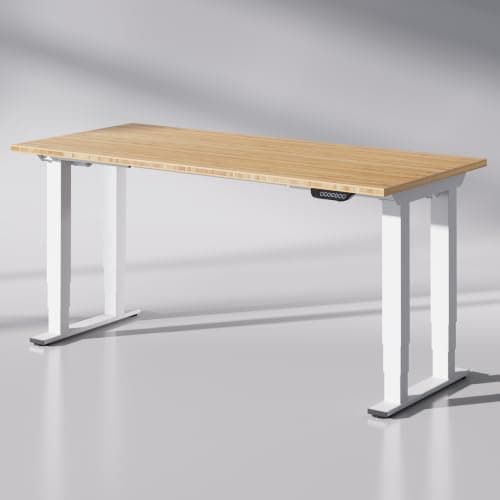
FlexiSpot E6Q Premium 4-Leg Standing Desk 72" x 30"

The four-leg case

FlexiSpot E6Q Premium 4-Leg Standing Desk 72" x 30"

7.5 /10
Researched

540 lb static, 440 lb lifting and support under the middle of a 72-inch span, bought at a 25.98in floor.

Full write-up below
$969.99View on Amazon

#ad · Price as of October 17, 2026 · Affiliate disclosure for the link to E6Q Premium 4-Leg Standing Desk 72" x 30"

UPLIFT DeskV3 Standing Desk FrameNo licensed photo yet

The two-leg case

UPLIFT Desk V3 Standing Desk Frame

9.1 /10
Researched

A 22.6in floor, 355 lb and fifteen years, with nothing in the middle of the under-desk bay.

Full write-up below
Check price on UPLIFT Desk

#ad · Price as of October 17, 2026 · Affiliate disclosure for the link to V3 Standing Desk Frame

The short answer

Buy four legs if your desktop is about six feet wide or more, or if your load is genuinely heavy: four legs put structure under the middle of the span, which is where a wide two-leg desk flexes. The FlexiSpot E6Q Premium is the case in point at 540 lb static, 440 lb lifting and a 51.57-inch ceiling. Buy two legs for anything narrower, and for anyone who sits for part of the day: a three-stage two-leg frame like the UPLIFT V3 drops to 22.6 inches against the E6Q's 25.98, and it leaves the under-desk bay clear for a chair, a walking pad or a drawer pedestal. Width and floor height decide this, not build quality — both layouts are made well and badly.

The decision in one paragraph

A two-leg desk is a bridge: two supports at the ends, a span between them, and your monitors in the middle of the span. A four-leg desk is a table: a support near each corner, and much shorter unsupported distances. Everything else follows from that, in both directions.

What four legs actually fix

Two things, and they are both measurable rather than matters of feel.

Deflection across a wide top. Load applied in the middle of a span bends the top and twists the frame, and the longer the span the more it does both. At 48 to 55 inches a good two-leg frame is rigid. At 72 to 78 inches the same frame is working much harder, which is why the two widest desks we rank — the FlexiSpot E6Q Premium at 72 inches and the FlexiSpot 78x32 — are both four-leg designs. The six-foot ranking is mostly a conversation about this.

Rated capacity. More legs means more motors and more columns carrying the load, and the ratings reflect it. The E6Q Premium publishes 540 lb static and 440 lb lifting, which is the largest figure in the heavy-duty ranking, against 355 lb for the UPLIFT V3.

What four legs do not change is the thing people buy them for most often: lateral sway at full extension. That is a function of leg-stage count, joint tolerances and how tightly the top is fixed to the frame. The wobble page goes through the actual causes, and a four-leg desk with loose joints wobbles just as happily as a two-leg one.

What they cost: the floor

This is the real price of four legs and it is paid in inches at the bottom of the range.

The number that decides it for most people

The UPLIFT V3 drops to 22.6 inches. The four-leg E6Q Premium stops at 25.98 inches, and the four-leg FlexiSpot 78x32 at 28.7 inches. A desk that will not drop below about 29 inches is a desk most adults cannot type at comfortably while seated, which turns a sit-stand desk into a standing desk. Get your own seated number before you shop.

Why does the floor suffer? Partly leg stages — most four-leg designs are two-stage, and a two-stage leg loses its travel off the bottom — and partly the cross structure that makes a four-leg frame rigid, which has to live somewhere.

What they cost: the space underneath

A two-leg frame leaves one clear bay the width of the desk. A four-leg frame divides the same floor into narrower bays with structure between them, and that structure is exactly where other things want to go.

  • A walking pad. Needs a clear rectangle roughly four feet long — belt length is the spec to check — and the gap between four legs is often narrower than the pad.
  • A drawer pedestal. Same problem; the drawers page works through the clearance.
  • Your chair. An armchair-width task chair rolls into a leg on a four-leg desk in a way it never does on a two-leg one.
  • Casters. FlexiSpot offers M8 casters on the E6Q Premium but states that the four-leg 78x32 takes neither casters nor under-desk drawers — so this is model-specific, not a rule.

The two, measured

Published specifications, four legs against two
FlexiSpot E6Q Premium (four legs)UPLIFT V3 (two legs, three-stage)
Height range25.98" – 51.57"22.6" – 48.7"
Capacity540 lb static, 440 lb lifting355 lb lifting
TopSold as a finished 72" x 30" deskFrame only; ten desktop sizes from 42x24 to 80x30
Under-desk floorDivided by four legs; takes M8 castersOne clear bay
WarrantyNot stated on the listing15 years, naming desktop, frame, motors and electronics
ControlsThree memory presets, USB port, sedentary reminderSynchronized motors, anti-collision

Choose by width

Applied to real desk sizes, the rule comes out like this.

  1. Up to about 60 inches: two legs, without hesitation. The span is short enough that a good two-leg frame is rigid, and you keep the low floor and the clear bay.
  2. 60 to 70 inches: two legs if the frame is three-stage and well rated; this is the band where either answer is defensible.
  3. 72 inches and up: four legs, or a two-leg frame with a genuinely thick top. Beyond six feet the middle of the desk is a long way from any support.
  4. Any width, very heavy load: four legs, for the capacity rather than the span.

One cheaper option worth naming: if the width is for a second monitor rather than for space, a monitor arm gets both screens off the desk and often removes the need for the extra foot of top entirely.

Two things four legs do not fix

Sway at full extension. Covered above: that is stages and tolerances, not leg count. The FlexiSpot 78x32 is four-legged and still has the lowest ceiling of any desk we rank at 47.2 inches, which is its own limitation.

A top that is too thin. Four legs reduce the span but the desktop still has to be stiff enough not to bow between them under a monitor arm clamp. A one-inch particle board top on any frame will do what one-inch particle board does.

The verdict

Two legs for most people, because most desks are under six feet and most people sit for part of the day — and the UPLIFT V3 wins this comparison on the two specs that disqualify a desk outright, floor height and warranty scope. Four legs when the top is six feet or wider or the load is genuinely heavy, where the E6Q Premium is the best-specified option we can cite and the floor height is the price you knowingly pay.

If you are choosing between frames rather than layouts, the frame ranking covers the whole field, and the choosing process puts this decision in its proper place — step three, after you know your own two numbers.
In detail

Both, in full

The four-leg caseResearched

FlexiSpot E6Q Premium 4-Leg Standing Desk 72" x 30"

540 lb static, 440 lb lifting and support under the middle of a 72-inch span, bought at a 25.98in floor.

7.5 /10
  • Height range 8.0
  • Stability at height 9.5
  • Warranty 4.0
  • Parts availability 7.0
  • Ease of buying 9.0

Specs, with sources

Height range
25.98" to 51.57", at up to 1.0 in/s source
Load capacity
540 lb static load, 440 lb lifting capacity source
Desktop
72" x 30", sold as a finished desk source
Frame and motors
Reinforced four-leg frame with a dual motor system, compatible with M8 caster wheels source
Controls
Control panel with three memory presets, a USB charging port and a sedentary reminder source

What works

  • A 51.57" ceiling is the second highest of any desk we rank, and the highest on a four-leg frame
  • 440 lb of lifting capacity, which is the most of anything here
  • Four legs put support under the middle of a 72-inch top rather than spanning it
  • Takes M8 casters, so it can be made mobile without losing the capacity

What doesn't

  • A 25.98" floor is nearly three inches above the UPLIFT V3 — poor for seated work below about 5'5"
  • Four legs eat the under-desk floor a walking pad or a rolling cabinet wants
  • Three memory presets rather than the four most desks at this price offer
  • FlexiSpot does not state a warranty term on this listing, which is a real gap at this money

Skip it if you sit for a meaningful part of the day and you are not tall — the floor is the binding number on this desk, and no amount of capacity buys it back.

FlexiSpot E6Q Premium 4-Leg Standing Desk 72" x 30"
$969.99View on Amazon

#ad · Price as of October 17, 2026 · Affiliate disclosure for the link to E6Q Premium 4-Leg Standing Desk 72" x 30"

The two-leg caseResearched

UPLIFT Desk V3 Standing Desk Frame

A 22.6in floor, 355 lb and fifteen years, with nothing in the middle of the under-desk bay.

9.1 /10
  • Height range 9.5
  • Stability at height 9.0
  • Warranty 9.5
  • Parts availability 9.0
  • Ease of buying 7.5

Specs, with sources

Height range
22.6" to 48.7" — a 26.1" span UPLIFT says fits over 95% of users source
Lifting capacity
355 lb source
Legs and motors
3-stage telescoping legs, synchronized precision motors in each leg source
Ergonomic standard
Adjusts to meet ANSI/BIFMA G1-2013 ergonomic guidelines source
Warranty
15 years, full coverage for desktop, frame, motors and electronics source

What works

  • Drops to 22.6", low enough for seated work at a normal chair height
  • Anti-collision reverses the desk on impact — worth having with a drawer or a pet underneath
  • 15-year warranty on motors and electronics is the longest here
  • Ten desktop sizes from 42x24 up to 80x30

What doesn't

  • Costs more than the FlexiSpot equivalent once you add a desktop
  • Frame-only buyers still need to source a top

Skip it if your budget stops at the frame — a V3 plus a real desktop lands well above the all-in price of a finished FlexiSpot.

UPLIFT DeskV3 Standing Desk FrameNo licensed photo yet
Check price on UPLIFT Desk

#ad · Price as of October 17, 2026 · Affiliate disclosure for the link to V3 Standing Desk Frame

How we picked

Every pick earns its place on the numbers

Each product here is chosen the way a well-informed buyer would choose it: read the maker's spec sheet, manual and warranty terms; record the figures that decide whether a desk fits a body and stays still at height; confirm replacement parts are actually sold; then score it against a published rubric. The UPLIFT V2 adds something extra — it is owner-tested long-term, the desk Mike bought and works at daily.

Scores are weighted editorial judgments from that documented research, shown as a criterion-by-criterion breakdown so you can see which strengths earned each ranking. Nobody pays for placement. The rubric and the weights are on the How We Pick page.

Questions

Frequently asked

Is a four-leg standing desk more stable?

Across a wide top, yes: four legs shorten the unsupported span, so weight in the middle produces less deflection. They do not reduce lateral sway at full extension, which comes from leg stages, joint tolerances and how firmly the top is fixed to the frame.

What is the downside of a four-leg standing desk?

A higher floor and a divided under-desk bay. The four-leg E6Q Premium stops at 25.98 inches and the FlexiSpot 78x32 at 28.7, against 22.6 inches for the two-leg UPLIFT V3 — and the legs sit where a walking pad, a drawer pedestal or a chair wants to be.

At what width do you need four legs?

About 72 inches. Up to roughly 60 inches a good two-leg frame is rigid; between 60 and 70 either layout is defensible; past six feet the middle of the top is a long way from any support and four legs start to earn their place.

Do four-leg desks have a higher weight capacity?

Usually, because there are more columns and more motors carrying the load. The E6Q Premium publishes 540 lb static and 440 lb lifting against 355 lb for the UPLIFT V3 — but the four-leg FlexiSpot 78x32 is only rated at 220 lb, so leg count alone does not guarantee a high figure.

Next

Receipts

Sources

Specs come from the maker's own spec pages and manuals; health claims from named medical institutions and published research; tax mechanics from IRS material. Where a figure isn't published, we say so rather than estimating it. Read the full method.