The short answer
The Steelcase Series 1 is the pick at this cap: height-adjustable lumbar support that slides to land on your own lower-back curve, a 400 lb rating, and a twelve-year warranty covering parts and labor. The Branch Ergonomic Chair is the one to buy if you want to verify fit before you order — it is the only chair here that publishes a seat height range (17" to 21") and a seat depth range (18" to 22"), with a seven-year warranty behind it. The SIHOO Doro C300 is the budget answer at a 330 lb load rating with BIFMA and TUV certification, trading a placeable lumbar support for a self-adaptive one. And the Vari Balance Stool is the cheapest useful thing on this page if what you need is a perch between standing bouts rather than a second task chair. Every figure is the maker's own published specification, cited below, and each listing was confirmed in stock before it was ranked.
What $500 is actually buying
Office chair pricing is anchored high. The chairs that get written about most cost three times this cap, which makes $500 feel like a compromise. It is not: $500 is the band where the four adjustments that decide whether a chair fits a specific human body all become available at once, and the first commercial-grade warranty appears.
Below about $200 you are buying a seat height lever and a recline that is really a spring. Between $200 and $500 you get real lumbar hardware, a published capacity rating, BIFMA certification and, at the very top of the band, a warranty that covers labor. Above $500 you are mostly buying materials, finish options and longer coverage — genuinely better chairs, but with a far smaller gap than the price difference suggests.
The one feature worth the whole budget
Lumbar support that adjusts vertically. Not lumbar support that exists, not a tension dial — support that slides up and down so it lands in the curve of your lower back. A fixed curve is designed for an average torso length. If yours is longer or shorter, it presses on the wrong vertebrae all day, which is worse than no lumbar support at all.
The four adjustments worth paying for
- Height-adjustable lumbar support. The one above. Only one chair on this page publishes it, which is why that chair leads.
- Seat depth. The adjustment nobody shops for and everybody needs: it decides whether the seat front presses behind your knees and whether your back reaches the lumbar support at all. A chair with great lumbar hardware and a fixed, too-deep seat is a chair whose lumbar support you will never touch.
- A published capacity rating, with headroom. Treat it as a durability figure rather than a limit. A chair rated well above your weight is a chair whose gas lift and base are not working at their design maximum every day.
- Warranty scope, then length. Parts-only coverage means you own the labor on a chair you cannot easily ship. Twelve years on parts and labor is a different product from twelve years on parts. The chair buying guide takes all four one at a time.
Two things are deliberately not on that list. Mesh versus foam is a comfort preference, not an ergonomic specification. And a headrest only helps if you recline — at a desk, upright, it is mostly decoration.
The four, one at a time
1. Steelcase Series 1 — best overall under $500
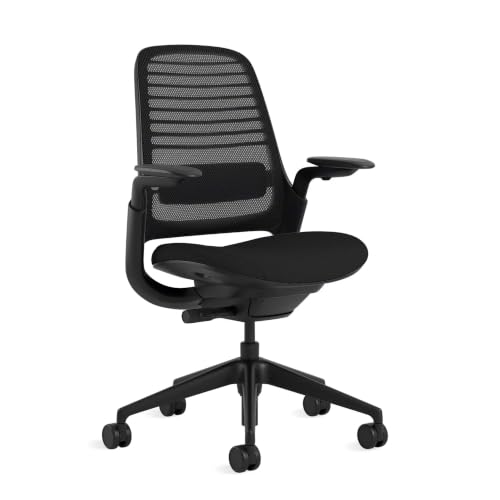
Steelcase publishes exactly the feature this page is built around: height-adjustable lumbar support that slides up and down to sit in the curve of your lower back. Add a seat that is both height- and depth-adjustable, weight-activated recline with an upright lock so there is no tension dial to set wrong, a 400 lb rating, and a limited twelve-year warranty on parts and labor in the US and Canada. Nothing else inside this cap has that combination, and it is the cheapest Steelcase that carries it.
The honest cons. It sits at the very top of the cap — close enough that a price move can put it outside, which is why the button on this page shows the live figure rather than one we typed. The Amazon listing is a specific configuration with carpet casters; if your floor is hard, that is a detail to check before ordering rather than after. Steelcase does not publish a seat height range on the listing the way Branch does. And it is a full task chair for the seated hours, not a perch — our full review covers both points at length.
2. Branch Ergonomic Chair — best published fit numbers
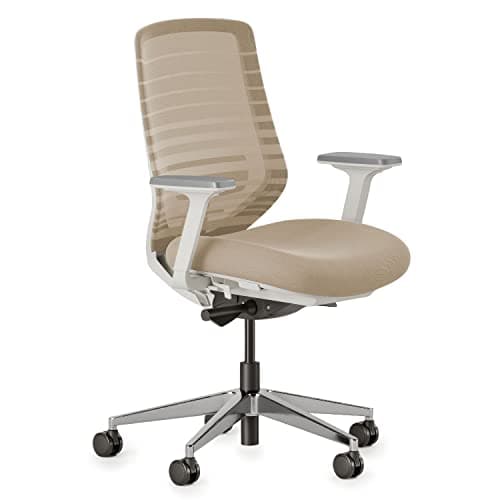
Branch states the two numbers you can actually check against your own body: a 17" to 21" seat height and an 18" to 22" seat depth. It adds padded two-way adjustable lumbar support, three-way adjustable armrests that remove entirely, weight-activated recline through a 20-degree tilt range, a BIFMA commercial-grade rating to 275 lb, and a seven-year warranty. Branch even publishes a stated fit range — 5 ft 2 in to 6 ft 2 in, up to 275 lb, at eight-plus hours a day — which is rarer than it should be.
The honest cons. 275 lb is the lowest capacity of the three chairs here, and the published fit range cuts off at 6 ft 2 in, so taller buyers should read it as a warning rather than a formality. Seven years is good; it is not twelve, and it does not name labor.
3. SIHOO Doro C300 — best budget pick
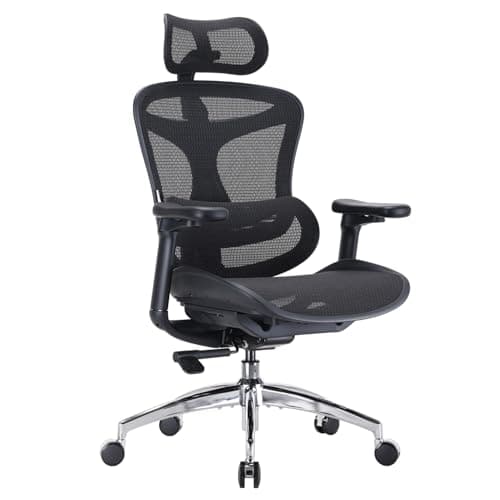
A 330 lb maximum load, BIFMA and TUV certification, 4D armrests that coordinate with the backrest, a headrest adjustable for height, depth and rotation, recline to 130 degrees, and a mesh back and seat that do not hold heat through a long block. At the bottom of this page's price range it publishes more adjustment per dollar than anything else we rank.
The honest cons. The lumbar support is self-adaptive — it flexes against your back as you move rather than sliding to a height you set. That is a real downgrade from the Series 1 on the single feature this page says matters most, and it is why the chair scores where it does. The warranty is three years, and the chair arrives flat and needs assembling. The full review is the long version of that trade.
4. Vari Balance Stool — best third position
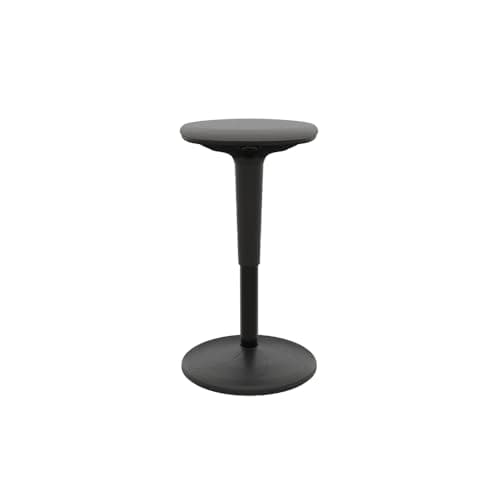
A pneumatic lift running 22" to 29" on a rounded base that rocks, tilts and pivots instead of holding you still, rated to 275 lb on a professional-grade gas lift, with a 14.5" seat on a 15.5" footprint at 16.1 lb. At roughly a third of this page's cap it is the cheapest genuinely useful seat here — if you understand what it is for.
The honest cons. It has no back support at all, so it is a twenty- to forty-minute position to rotate through, not a chair you work a day in. It tops out at 29", which is a low perch rather than a standing-height one. And Vari does not state a warranty term on the listing, against Steelcase's twelve years. Chair versus stool is the full comparison.
The four, measured
|
| Steelcase Series 1 | Height-adjustable, slides to your curve | 400 lb | 12 years, parts and labor |
| Branch Ergonomic Chair | Padded, two-way adjustable, height-adjustable | 275 lb, BIFMA | 7 years |
| SIHOO Doro C300 | Self-adaptive, not placeable | 330 lb, BIFMA and TUV | 3 years |
| Vari Balance Stool | None — active base, no backrest | 275 lb | Not stated on the listing |
Read the lumbar column first and the price second. That column is the whole ranking: the chair that lets you place the support where your spine actually curves is worth more than the chair with more adjustment points elsewhere.
What changes when the desk moves
A task chair is designed for a desk at one seated height. Once the desk moves, a third position appears that neither sitting nor standing covers: perching at a desk raised somewhere between the two. None of the three chairs above does that well — their seat height ranges stop far below a raised desk — which is the entire reason the stool is on this page.
The practical rule: buy the chair first, because you sit more than you stand and the seated hours are when the lumbar curve collapses. Add the perch second, once you know you will use it. If you are budgeting a whole setup at once, the under-$1,000 desk ranking is the companion page to this one — a chair at this cap and a desk at that one is a complete, honest workstation, and the budget setup guide sequences the rest of it.
What $500 does not buy
- A fit guarantee. No chair fits every body. The reason this page keeps returning to published numbers is that a seat height range you can measure against your own leg is worth more than any amount of review prose.
- A cure for back pain. A chair that fits reduces the time your spine spends in a shape it dislikes. That is useful and it is not treatment — the back-pain ranking is explicit about where the evidence stops.
- Twelve-year coverage on most of the field. One chair here publishes it. Three to seven years is the norm at this cap, and that is the main thing more money buys above it.
- Assembly-free delivery. Expect a box and a hex key on everything except the stool.
Why no prices appear in this text
Read this before treating the cap as a promise
There is not a dollar figure typed into the body of this page, and that is deliberate on a page whose premise is a price cap. Chair prices move constantly and every maker here runs promotions. Every price on this page comes live from the retailer; where we cannot hold a verified live figure, the button says "check price" rather than quoting one we cannot stand behind.
All four seats were inside $500 when this page was written and checked, and all four were listed in stock. The Series 1 sits closest to the line, so if you are holding to the cap strictly, check its live figure before you plan around it.
What we left out, and why
The chairs everybody expects on a list like this are missing on purpose. Herman Miller and refurbished Aeron listings sit on Amazon at prices well below a new chair, but condition, seller and warranty status could not be proved from the listings, and a chair whose coverage we cannot verify fails this page's own warranty criterion. Several other candidates were dropped for a simpler reason: their makers publish no seat height range, no seat depth range and no capacity figure, which makes the fit question unanswerable.
Gaming chairs are absent as a category. A bucket seat with a strap-on lumbar pillow adjusts in fewer meaningful ways than any chair above, whatever the spec sheet says about materials.
And we did not pad the list. Three chairs and a stool is what the cap supports once "publishes the numbers that decide fit" is the entry requirement. If your constraint is the use case rather than the price, the home office chair ranking sorts the same field by what a full working day asks of a chair, and the stool ranking covers active seating in its own right.
Nothing on this page has been used by anyone here. Every figure above is the manufacturer's or the retailer's published specification, cited below, and the method is published in full.