The short answer
Buy a sit-stand desk if you work at it for more than about four hours a day — it does everything a fixed desk does and adds the ability to change position, which is the part that matters. Expect to pay roughly two to four times what an equivalent fixed desk costs, and to give up nothing else: a modern three-stage frame drops to around 23.6", which is lower than most fixed desks sit, so it is a better seated desk as well as a standing one. If you use the desk for an hour a day, or the budget is tight, a fixed desk plus a converter gets you the same change of position for less.
The short answer
The usual framing — standing is good for you, sitting is bad for you — is not the useful one, and the evidence behind it is thinner than the category implies. Standing versus sitting covers what is actually established. The buying question is narrower: does changing position during a long working day solve a problem you have?
What actually differs
|
| Height | Typically fixed near 29" to 30" | Adjustable, commonly 23.6" to 48.8" |
| Seated fit | One height, chosen for an average adult in shoes | Set to your own elbow height |
| Standing | Not possible | The whole point |
| Moving parts | None | Motors, a control box and a handset |
| Typical spend | Low | Two to four times as much |
| Warranty to look at | Structure only | Frame and motor, then the electronics separately |
The row people skip is the second one. A fixed desk is set to a compromise height for an average body; an adjustable desk is set to yours, which is a real benefit even if you never stand at it once.
The price gap, honestly
A sit-stand desk carries motors, a control box, a handset and a frame engineered to move thousands of times. That is the cost, and it is also the thing that can fail — a fixed desk has nothing to break.
What a standing desk actually costs breaks the market into bands. The short version: the value band is $300 to $500, and below about $280 the usual casualty is the bottom of the height range.
Three buyers it is clearly right for
- Anyone at the desk more than four hours a day. The longer the session, the more a change of position is worth, and the more a fixed compromise height costs you.
- Anyone who does not fit a 29-inch desk. Shorter and taller users are both badly served by the fixed standard, and an adjustable desk fixes that at the seated height alone.
- Anyone sharing a desk. Two bodies, one surface, memory presets — shared-desk setups is the page for that.
Three it is not
- An occasional desk. An hour a day at a laptop does not need a motorised frame.
- A desk you will load to the ceiling. A very heavy setup on a budget frame is the combination that ages worst — capacity headroom explains why.
- A fix for back pain on its own. It is a tool for changing position, not a treatment — what the evidence supports.
The option in the middle
A converter sits on the desk you already own and raises the keyboard and screen. You keep your existing seated height, you spend a fraction of the money, and you give up desk depth and a platform you have to lift.
For a lot of people that is the right answer and nobody tells them — the desk-versus-converter comparison is the honest version, and are converters worth it covers the trade.
From the picks
One of each
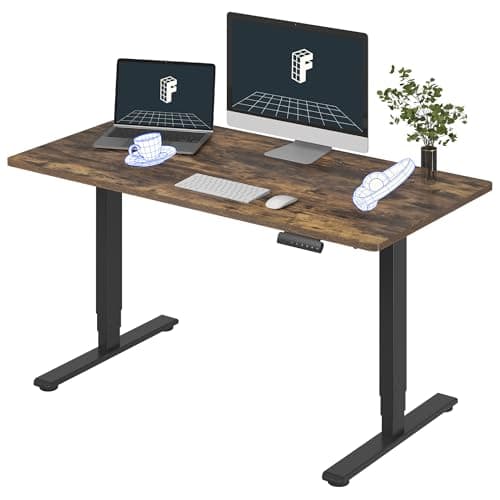
Three-stage legs, dual motors and four memory presets under a one-piece 55" top, at the price most two-stage desks ask — the best value of any full desk we rank.
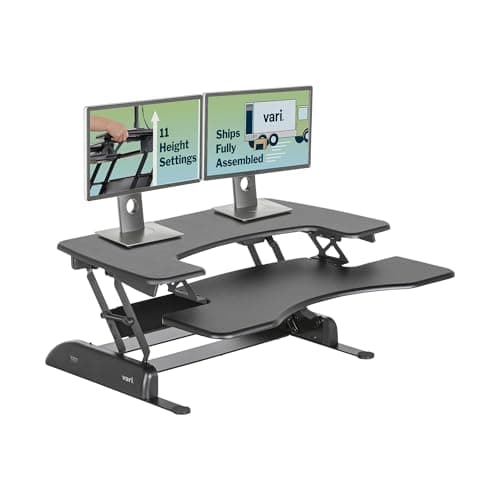
The converter everyone else is measured against: spring-assisted, arrives assembled, lifetime warranty. It rises 17.5", which is enough for most people at a 29" desk and not enough above about 6'2".
UPLUPLIFT DeskV3 Standing Desk FrameNo licensed photo yet
Best current-generation buy
The V2's replacement, and the one that will actually be in stock. UPLIFT puts the range at 22.6" to 48.7" — a lower floor than the V2, which matters more than the ceiling for most people — on the same 355 lb rating and 15-year warranty.