The short answer
A sit-stand desk is worth it if you will actually alternate — and that depends on three things: the desk reaching both your seated and your standing height, moving fast enough that changing position is not an interruption, and your floor being tolerable to stand on. What the desk reliably delivers is less sitting: Cochrane's 2018 review found sit-stand desks cut sitting by roughly 84 to 116 minutes per workday, on low-quality evidence, and concluded the health effects are still unproven. It is not a weight-loss device and it cannot correct a structural back problem. Bought for the right reason it is one of the better pieces of furniture you can own; bought for the marketed reasons it is a disappointment.
The short version
We sell standing desks on this site, which is exactly why this page has to be straight with you.
The honest position is: the mechanism is well-supported — prolonged uninterrupted sitting is worth breaking up — and the magnitude of the health benefit from a desk specifically is not established. A desk makes alternating easy. Alternating is the thing with a plausible case behind it. Standing for eight hours instead of sitting for eight hours is not the goal and carries its own problems.
So the useful question is not "do standing desks work". It is "will this desk, in your room, get raised and lowered several times a day for years". Everything on this page is about that.
What the evidence actually says
Two sources worth reading in full, and they point in slightly different directions.
Cochrane, 2018. Shrestha and colleagues reviewed workplace interventions for reducing sitting at work. Sit-stand desks reduced sitting by roughly 84 to 116 minutes per workday in the short and medium term — a genuinely large behavioral effect. The evidence was graded low quality, there was no evidence at longer follow-up, and Cochrane's own plain-language summary states that the health effects of sit-stand desks and interventions aimed at reducing sitting at work are still unproven.
UT Southwestern Medical Center. Their clinical blog takes a more encouraging line on one specific outcome: using a standing desk properly "might help relieve back pain caused by excessive sitting", citing a 2018 study that reported a 50% decrease in low back pain among sit-stand desk users. They also cite a 2017 Circulation study at roughly 0.15 extra calories per minute standing versus sitting — about 54 calories across six hours — and a 2016 call-center study in which sit-stand users were 45% more productive.
How to hold those two together
A single study reporting 50% less back pain and a systematic review grading the whole literature as low quality are not in conflict; they are different levels of evidence. The defensible summary is that sit-stand desks clearly change behavior, plausibly help sitting-related back pain, and have not been shown to deliver broader health outcomes. Note what 54 calories across six hours means in practice: standing is not a calorie strategy, and any page quoting you a precise burn figure for a standing desk invented it.
If back pain is specifically why you are here, the dedicated pages are more careful than this one can be: the back-pain guide, sciatica and herniated disc each state the limits as the sources state them.
What standing too much costs
This is the half the marketing leaves out, and UT Southwestern states it plainly.
Standing too much brings its own problems: leg pain, swelling, and — for patients already at risk — deep vein thrombosis and varicose veins. And a standing desk cannot correct serious structural problems such as scoliosis or a bulging disc. Their practical guidance is to transition gradually, use an anti-fatigue mat, keep the ergonomics right, and "change positions, shift your weight, and take short walk breaks every 30 minutes".
Read that guidance as a product specification, because that is what it is. It says you need a desk that is easy to move, a surface that is tolerable to stand on, and a reason to change position often. Those are purchasable things — a mat, a desk that moves quickly, and a dosage pattern you can actually keep. What it does not say is "stand all day".
The real case for one
Four reasons that survive the evidence above, in descending order of how well they hold up.
- It makes the alternating effortless. The behavioral effect Cochrane measured is large and real. Breaking up eight hours of continuous sitting is worth doing, and a desk that changes height in twelve seconds is the lowest-friction way to do it.
- It fits the desk to your body, not the other way round. This is the one nobody markets and it may be the biggest. A fixed desk is built at about 29 to 30 inches regardless of who sits at it. A sit-stand desk set to your seated number from the calculator is correct ergonomics for you, seated, before standing enters the picture at all.
- Sitting-related back pain. Reported in the study UT Southwestern cites, and consistent with the mechanism. Worth having as a reason; not worth banking on as a cure.
- It opens the door to walking. If you ever want a walking pad, a height-adjustable desk is the prerequisite.
From the picks
If the answer is yes, three ways in
The desk worth keeping for fifteen years, the mainstream pick most people should buy, and the converter that tests the idea on the desk you already own.
UPLUPLIFT DeskV3 Standing Desk FrameNo licensed photo yet
Best current-generation buy
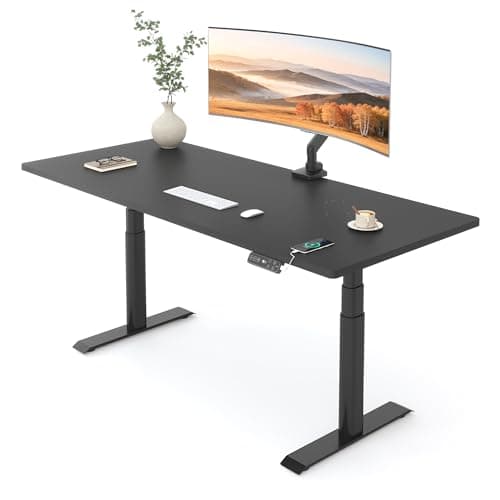
The V2's replacement, and the one that will actually be in stock. UPLIFT puts the range at 22.6" to 48.7" — a lower floor than the V2, which matters more than the ceiling for most people — on the same 355 lb rating and 15-year warranty.
The same footprint and the same range as the E6, with half again the capacity, a quieter motor pair and double the frame warranty. It is the version worth the difference for most desks.
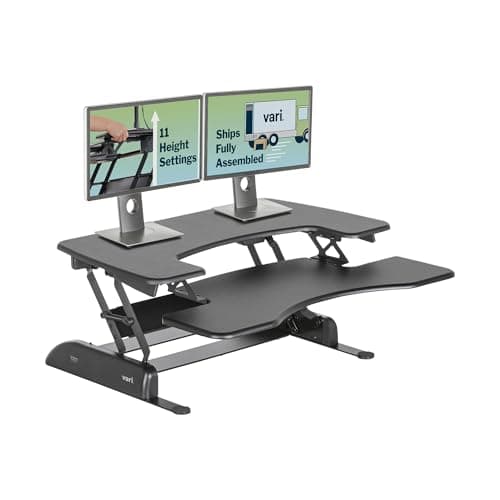
The converter everyone else is measured against: spring-assisted, arrives assembled, lifetime warranty. It rises 17.5", which is enough for most people at a 29" desk and not enough above about 6'2".
Three conditions for it to be worth it
Every unused standing desk we have ever heard about failed one of these three. Check them before you spend anything.
- It reaches both your numbers. Standing height with an inch or two of headroom, and a floor at or below your seated height. A desk that only does one position is not a sit-stand desk, and plenty of cheap desks have floors around 29 inches — see why two-stage frames give up the bottom of the range.
- It moves fast enough that you do not resent it. Three-stage legs and two motors put a position change at about twelve seconds. A two-stage single-motor desk can take four times that, and a desk that feels like an interruption stops getting used. The motor comparison is the short version.
- Standing where you stand is tolerable. On tile or concrete, in socks, forty minutes is about the limit before you reach for the down button. That is a mat problem with a cheap solution, and it is the condition people discover rather than check.
Worth it, for whom
|
| Eight hours a day at a desk, no current back problem | Yes | The behavioral effect is real and the ergonomic fit alone justifies it |
| Sitting-related lower back pain | Probably | Supported by the study UT Southwestern cites; not a treatment, and worth clinical advice first |
| A diagnosed structural problem — disc, scoliosis | Not on its own | UT Southwestern states a standing desk cannot correct these |
| Hoping to lose weight | No | Roughly 0.15 extra calories per minute standing — about 54 across six hours |
| Two hours a day at the desk | Marginal | Not enough continuous sitting for the mechanism to matter much |
| You rent, or do not own the desk | Yes, as a converter | Preserves your seated position and comes off the desk again |
| Budget under about $300 | Yes, as a converter | A cheap desk at that price usually loses the seated position |
When to buy something else
If the three conditions do not hold, there are better places for the money.
A chair that actually supports you. If you are going to sit most of the day regardless, a chair with height-adjustable lumbar support does more for your back than a desk you do not raise. That ranking is here, and the chair buying guide covers what to look for.
A converter. The cheap experiment. It keeps your existing seated position and adds a real standing one, which a budget desk often does not — the honest case for one is its own page.
A monitor arm and a mat. Under a hundred dollars between them on many desks, and the two accessories most likely to change how your current setup feels. In buying order, here.
Nothing, and a timer. The intervention with the best evidence behind it is free: change position, shift your weight and take a short walk every thirty minutes. The dosage page treats it properly, and if the answer turns out to be a desk after all, the choosing process is seven steps long.
Nothing in this analysis is medical advice, and nothing on this page has been clinically evaluated by anyone here. Every research claim above is cited below and stated at the strength its source states it — including the parts that undercut the product.