The short answer
The MERACH UltraWalk W60 is the value answer: a 400 lb peak rating on a 16.5" x 41.3" deck, a brushless motor with its own cooling vents, a published noise figure of around 54 dB and twelve levels of automatic incline. The UREVO SpaceWalk 3S is the all-rounder, with the longest belt of the three at 42.5" and a 4.0 mph ceiling. The UREVO CyberPad for Office is the one for heavy users, rated to 400 lb with automatic incline to 14%. What none of them replaces is the thing the WalkingPad is bought for: folding in half and disappearing. Every figure below is the maker's own published specification or its listing, cited at the foot of the page, and every pad here was confirmed in stock before it was ranked.
What a WalkingPad actually is
A page called "alternatives" is worth nothing if it does not first say what it is offering an alternative to, so here is the KingSmith WalkingPad C2 on KingSmith's own published numbers rather than on reputation.
KingSmith's proposition is a treadmill that folds in half and goes away. The C2 stores at 32" x 20" x 5.5" — short enough to stand behind a door or slide under a bed — at a net weight of 55 lb, and it still gives a 47.2" x 15.8" walking area when it is open, which is longer than several pads that do not fold at all. KingSmith publishes 0.5 to 3.7 mph on a 1 HP brushless motor, a 220 lb capacity, and states that idling noise has been lowered to 65 decibels. The brand name has become the category name for a reason: it solved storage first, and most of the market followed.
The thing the WalkingPad is genuinely hard to beat on
Storage, by a distance. A 47.2" belt that folds down to a 32-inch footprint is a combination nothing below matches — the three alternatives here are all pads you put somewhere and leave. If the pad has to disappear between sessions, this page is the wrong page and the C2 is the answer.
For the version of this question that keeps the C2 in the running, we have the full WalkingPad C2 review and the under-desk pad ranking. This page assumes you have already decided to look elsewhere.
Why people shop around
Four reasons come up, and none of them is "the pad is bad":
- 220 lb is the lowest capacity in this catalog. Capacity is not really about whether the belt holds you — it is about headroom, because a motor working near its rating is a motor with a short life. What a walking pad weight limit actually means is the page for that.
- 3.7 mph is a walking ceiling, not a brisk one. Two of the three pads below run to 4.0 mph. For taller users especially, the difference between 3.7 and 4.0 is the difference between a stride and a shuffle.
- No incline. The C2 is flat. Every pick on this page has automatic incline, which is the cheapest way to make a slow walk into real work without more speed.
- A 15.8" belt is narrow. It is workable, and it is the narrowest here — the three alternatives all run 16.5" or wider, which buys margin for the drift that happens when you are watching a screen and not your feet.
What an alternative has to match
Four published specifications, in the order they decide the purchase:
- Belt length against your stride. This is the number that decides whether a pad is usable, and it is the one most listings bury. The belt length guide turns your height into a minimum before you compare anything else.
- Capacity with headroom above your own weight. Not a pass/fail check — a margin. The further you sit under the rating, the less the motor works for every hour you walk.
- A published noise figure, or an honest absence of one. Under a desk in a room with other people, noise is the spec that decides whether the pad gets used. Some makers publish a decibel number; some do not, and that gap is worth noting rather than guessing at.
- Where it lives when you are not on it. The C2 folds. None of these do. Measure the floor under or beside your desk before you order, because that is the permanent cost of every pad here.
How this page is ordered
By how much of the WalkingPad brief each pad actually replaces at the money it asks, not strictly by our overall score. The W60 and the SpaceWalk 3S are close on the rubric and the CyberPad scores highest of the three on capacity alone, which is why it leads the high-capacity ranking. The narrower question here — which pad is the most complete replacement — puts the W60 first. Both orderings are defensible; saying which question each page answers is the honest part.
The three, one at a time
1. MERACH UltraWalk W60 — best value
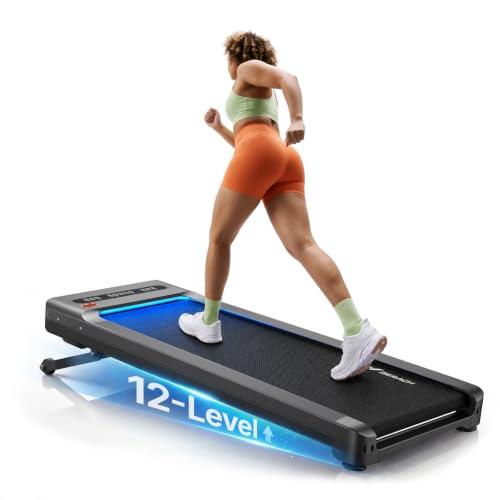
MERACH publishes a 16.5" x 41.3" walking surface, up to 400 lb peak and 330 lb sustained capacity, a 1.25 CHP continuous / 3.5 HP peak brushless motor with Hall sensor control and dual-vent cooling, around 54 dB in average use, and twelve levels of automatic incline. Against the C2 that is nearly double the capacity, a wider belt, a published noise figure that is lower rather than higher, and a hill the C2 does not have. It is the value answer here: the most machine per dollar of the three, which is why it leads the page.
The honest cons. It does not fold, and at 67.7 lb it is built to stay where you put it rather than go into a closet. The deck is also almost six inches shorter than the C2's, which matters if you are tall — that is the trade for the capacity and the motor. Our MERACH lineup review covers both of MERACH's pads, including the NovaWalk W50 step-down, whose Amazon listing was out of stock when this page was written.
2. UREVO SpaceWalk 3S — best all-rounder
UREVO publishes a 42.5" x 16.54" walking area on a seven-layer belt, 0.6 to 4.0 mph, nine-level automatic incline and a 265 lb capacity. That is the longest deck of the three, the same 4.0 mph ceiling as the CyberPad, and finer incline control than a two-position ramp. If you want one pad that is not bad at anything, this is it.
The honest cons. 265 lb sits between the C2 and the two 400 lb pads, so the headroom argument is weaker here than on either UREVO sibling. UREVO publishes no operating-noise figure we can cite for it, and we would rather say that than invent one. And there is no single Amazon listing we could verify as this exact model, so its buy button runs a tagged search rather than pointing at one listing — check the model name on the page you land on before you order.
3. UREVO CyberPad for Office — best for heavy users
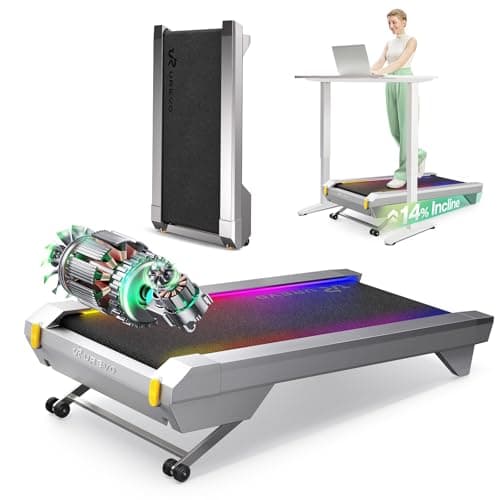
UREVO publishes support for users weighing up to 400 lb, a 39.4" x 16.5" walking area, and 0.6 to 4.0 mph with 0 to 14% automatic incline. That is the steepest incline on this page and the joint-highest capacity, which together make it the pad for someone who wants the walk to count as exercise rather than as background movement.
The honest cons. The 39.4" belt is the shortest here and nearly eight inches shorter than the C2's — it suits strides up to about 5'10", and taller walkers should read the belt length guide before choosing it. Like the other two, it does not fold.
The three, measured
|
| KingSmith WalkingPad C2 (reference) | 47.2" x 15.8" | 220 lb | 0.5 - 3.7 mph, no incline | Yes — 32" x 20" x 5.5" |
| MERACH UltraWalk W60 | 41.3" x 16.5" | 400 lb peak, 330 lb sustained | 12 levels of automatic incline | No |
| UREVO SpaceWalk 3S | 42.5" x 16.54" | 265 lb | 0.6 - 4.0 mph, nine incline levels | No |
| UREVO CyberPad for Office | 39.4" x 16.5" | 400 lb | 0.6 - 4.0 mph, 0 - 14% incline | No |
Read that as three separate decisions rather than a league table. The longest belt of the alternatives is the SpaceWalk 3S — and the longest belt overall is still the reference row. The most capacity is the W60 or the CyberPad. The steepest hill is the CyberPad. And the only pad that goes away when you are done with it is the C2.
What none of them replaces
Three things, and pretending otherwise would make this page useless:
- Folding in half. This is the WalkingPad's whole argument. If your pad has to live in a closet, under a bed or behind a door between sessions, none of these three can do it and the C2 can.
- A 47.2" belt in a small room. The C2 pairs the longest deck here with the smallest stored footprint. The alternatives give you a deck that is level with or shorter than it, and keep the floor space permanently.
- 55 lb you can move alone. The W60 is 67.7 lb and built to stay put. Moving a pad between rooms regularly is a real requirement, and it points back at the folding design.
If the answer is still a WalkingPad
That is a perfectly reasonable place to land, and the site has pages for it: our WalkingPad C2 review covers what the folding design buys and what it costs, and the under-desk pad ranking puts the whole field side by side. If incline is the feature that sent you looking, the incline ranking is the narrower page, and the quiet ranking is the one for a pad that has to share a room with other people. If you are still deciding whether a pad is the right machine at all, walking pad versus treadmill is the page upstream of all of this.
Nothing on this page has been used by anyone here beyond the UPLIFT V2 we own. Every specification above is the manufacturer's or the retailer's published figure, with the document it came from linked below, and the method is published in full.